
Popular Economics
“Advance estimates of U.S. retail and food services sales for July 2026, adjusted for seasonal variation and holiday and trading-day differences, but not for price changes, were $763.6 billion, down 0.6 percent (±0.4 percent) from the previous month, but up 5.0 percent (±0.5 percent) from July 2025.” Census.gov
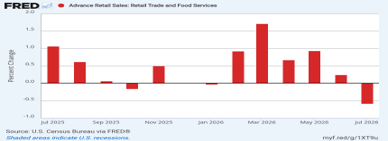
The alarming FRED’s retail sales graph above showed sales had plunged in August after a spending surge earlier in the year. Consumers had already spent the tax perks from Trump’s Big Beautiful Tax Bill.
The U.S. economy is shrinking. Does this signal a breaking point, are consumers shopping less to preserve some of their declining savings? It is already happening, shown in part by consumer sentiment surveys.
The University of Michigan survey showed a decline in their finances.
“Consumer sentiment fell about 8% this August, ending two consecutive months of improvement,” said Survey Director Joanne Hsu. “While views of personal finances saw only minor declines, expected business conditions sank 11% for the short run and 17% for the long run. Decreases in sentiment were seen across the political spectrum, with Republicans exhibiting the strongest month-to-month decline in August.”
If so, it’s a major danger signal that consumers, who account for two-thirds of economic activity, can no longer support as much economic growth. That leaves investment activity from the record corporate profits the sole leg propping up the financial markets’ record levels.
The retail sales decline is also another sign the U.S. population is no longer growing, and the immigration deportations will only make it worse because immigrants, legal or illegal, are shoppers.
The U.S. Census Bureau reports our population grew at a much slower rate between July 2024 and July 2025 than from 2023 to 2024 (when it increased by 1.0%, or 3.2 million people). “The slowdown is largely due to lower levels of net international migration.”
Consumers’ incomes are not keeping up with inflation as well. Wages rose 3.2 percent per annum whereas retail inflation rose 3.5 percent in the latest month. So, shoppers must now borrow more to keep up their standard of living, which takes a bigger slice of their incomes.
So the job market is shrinking, to no one’s surprise. But July’s catastrophic unemployment report tells us the loss of -23,000 payroll jobs was particularly alarming. Will the $trillions in AI investment replace those jobs and keep inflation from rising more?
I doubt it, since most of the inflation is due to the Trump administration’s tariffs and two wars still raging. It’s the stagflation scenario of the 1970s all other again—energy shortages + higher inflation + stagnant economic growth for years to come.
Harlan Green © 2026
Follow Harlan Green on Twitter: https://twitter.com/HarlanGreen


