Where is the Inflation, Higher Growth?

Financial FAQs

The drumbeat for a higher inflation target is picking up. The Chicago Fed’s Charles Evans recently advocated a less hawkish Fed stanch on maintaining the 2 percent inflation target with few signs of inflation even on the horizon.

Elizabeth Sawhill, a Senior Fellow at Brookings in a New York Times Op-ed, on the heels of February’s almost record 313,000 job creation number, is also saying that higher inflation would be desirable after many years of too low inflation.

“In fact, a high-pressure economy, with wages and prices a little higher than we’ve become used to, might actually do a lot of good for the people who need it most,” said Sawhill. “Working families need a tight labor market — and higher wages — to get ahead. It would be a costly mistake to raise rates too much or too soon.”

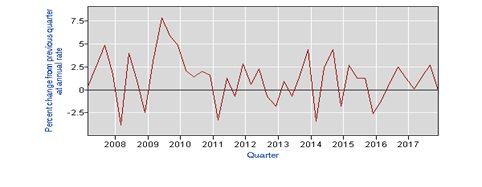
I have been saying this for years, as we know that higher growth and higher inflation go hand-in-hand, which in turn boosts wages. The Fed’s preferred PCE and retail CPI indexes have remained below 2 percent since 2008, while the GDP growth rate has also averaged just 2 percent.

image

Graph: tradingeconomics.com

Why don’t we have higher growth? Because higher GDP growth requires that corporate profits reach those that will invest or spend them, including governments, working folk, and corporations have been better at buying back their own stock rather than investing their profits, as I’ve also been saying in past columns. While governments have been living on austerity budgets since the Great Recession.

“We are in the midst of a big fiscal and monetary experiment, says Sawhill. “And as with any experiment, the consequences are unknown. What we do know is that the costs of the Great Recession were enormous — at least $4 trillion in lost income, or about $30,000 per household, according to my calculations. The biggest losses were experienced by those in the bottom and middle portions of the income distribution who lost jobs and saw much of the equity in their homes destroyed.”
image

What is the best way to boost growth and wages? It is very basic economic theory. By taxing those that don’t invest their profits in productive uses—the wealthiest among us and corporations—which would allow governments to spend more on education, infrastructure, environmental protection, R&D, health care; need I go on? By doing so, we boost extremely low labor productivity, when even a slight boost in productivity can boost everyone’s standard of living.

So it really means reversing the politics du jour in Washington that is paid for by Big Business lobbyists, and the Fed policy of raising interest rates before there are any real signs of inflation.

Harlan Green © 2018

Follow Harlan Green on Twitter: https://twitter.com/HarlanGreen
Posted in Consumers, Economy, Macro Economics, Politics, Weekly Financial News | Tagged , , , | Leave a comment

A Gangbusters February Employment Report

Popular Economics Weekly

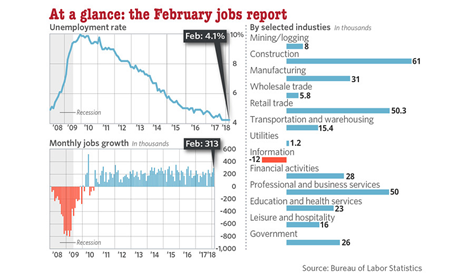
The U.S. added 313,000 new jobs in February, the biggest gain in a year and a half and clear evidence that a strong economy has plenty of room to keep expanding, said Marketwatch. The unemployment rate of 4.1 percent remained at a 17-year low.

And despite the big increase in hiring, wage growth did not keep up. Hourly pay rose 4 cents to $26.75 an hour, but the yearly increase in wages tapered off. The 12-month increase in pay slipped to 2.6 percent from a revised 2.8 percent in January.

image

Graph: Marketwatch

Construction companies hired 61,000 people to mark the biggest increase in 11 years. Retailers added 50,000 jobs, as did professional-oriented businesses. And manufacturers filled 31,000 positions. Workers also put more time in on the job, reversing a weather-induced decline in the first month of the year.

What’s more, the economy added 54,000 more jobs in January and December than previously reported. Altogether, the economy has gained an average of 242,000 new jobs in the past three months. That’s much stronger than the 182,000 monthly average in 2017.

Hourly pay is still not rising fast enough to cause inflation. We have to watch the 10-year T Bill for any signs of future inflation. Its yield is still below 3 percent, so the Fed might not raise their rate as quickly. The Chicago Fed’s Charles Evans just suggested the Fed could wait until mid-year before hiking short term rates.

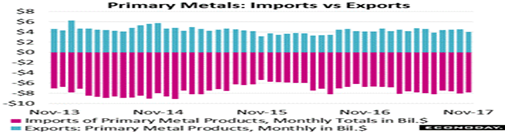
But effects of the steel and aluminum tariff hikes will be the big unknown for inflation. If this initiates a trade war with the EU and China, in particular, all bets are off for continued high growth as rising primary metal prices will boost inflation with a vengeance, and endanger the jobs of those 6 million workers that make products from those metals.

image

Graph: Marketwatch

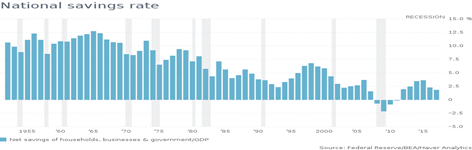
There is also a problem with our national savings rate. Marketwatch’s Rex Nutting points out it has sunk to a post-WWII low, which means more foreign investment than ever is needed to fund our balance of payments problem; something better trade agreements won’t cure. Because Americans still like to import more consumer goods than they export manufacturing goods and services, as I said yesterday.

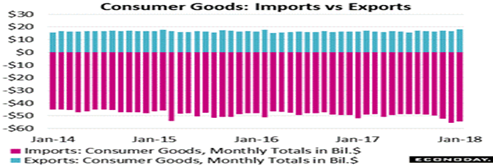
Consumer products and automobiles are the primary drivers of the current $566 billion trade deficit. In 2017, the United States imported $602 billion in generic drugs, televisions, clothing, and other household items. It only exported $198 billion of consumer goods. The imbalance added $404 billion to the deficit. America imported $359 billion worth of automobiles and parts, while only exporting $158 billion.

So there are many caveats to continued strong jobs growth in 2018. Firstly we can’t have a trade war, and secondly, foreign investors still must buy enough US stocks, bonds, and Treasury securities to keep long term interest rates stable.

Harlan Green © 2018

Follow Harlan Green on Twitter: https://twitter.com/HarlanGreen
Posted in Consumers, Economy, Macro Economics, Weekly Financial News | Tagged , , , , | Leave a comment

Whither Go Interest Rates?

The Mortgage Corner

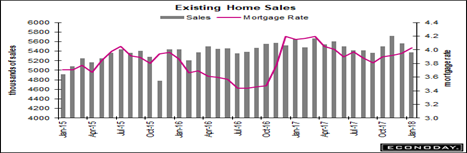
Existing-home resales weakened in January as the NAR’s pending home sales index fell sharply and is pointing to trouble for final sales of existing homes where the year-on-year rate for January had already fallen back below the zero line to minus 4.8 percent. Econoday reports new home sales also disappointed in January, sinking below the zero line on a year-over-year basis to minus 1.0 percent. 

image

Graph: Econoday

This has to be a consequence of the slight uptick in mortgage rates that have been at historical lows for more than 2 years. Many homeowners and buyers simply can’t afford this slight rise in mortgage rates, even though the conforming 30-year fixed rate is still at 4.0 percent for a 1-pt. origination fee, and 0 pts. @ 4.25 percent.

image

Higher interest rates usually follow higher inflation, but the only inflation is showing up in stock (and bond) prices, which is where most corporate profits are flowing these days; into investor and CEO pockets, rather than into consumers’ pockets. It is why one-quarter of the American workforce earns below the poverty line of $10/hour for a family of four.

It would help to see a rise in minimum wages. But the national minimum wage has been stuck at 7.25 percent since 2009, due to congressional inaction. This is the result of more than 30 years of trickle-down economics that has pushed most of America’s wealth to the top 10 percent of income earners.

In 2012, the top 10 percent of earners took home 50 percent of all income. That’s the highest percent in the last 100 years. The top 1 percent took home 20 percent of the income, according to a study by economists Emmanuel Saez and Thomas Piketty.

So what has really happened is housing prices are now rising twice as fast as household incomes, thanks to such low interest rates. That is where we see inflation; but not in household incomes which need to rise faster if housing is to remain affordable.

Harlan Green © 2018

Follow Harlan Green on Twitter: https://twitter.com/HarlanGreen

Posted in Consumers, Economy, Housing, housing market, Politics, Weekly Financial News | Tagged , , , , | Leave a comment

How Bad Is Our Trade Deficit?

Financial FAQs

President Trump just announced a 25 percent tariff (tax) on imported steel, and 10 percent tariff on aluminum. Will this improve our 2017 $566 billion trade deficit? Can we lower our trade deficit with higher tariffs on such strategic products? Is the deficit so dangerous to our economic health that we have to lower it in this way?

No, because most of the trade deficit comes from US consumers’ love of imported goods–$54.3 billion in January, according to Econoday. In 2017, the total U.S. trade deficit was $566 billion. It imported $2.895 trillion of goods and services while exporting $2.329 trillion.

image

Graph: Econoday

Whereas the trade gap in primary metals is minuscule. This gap totaled $3.8 billion in the latest data for this reading which is November. Econoday says, “But here it’s important to note that this deficit isn’t only one way. U.S. firms actually exported a very sizable $4.0 billion in primary metals to foreign buyers in the month as tracked in the blue columns of the graph, a sum that could be at risk should a trade battle for metals begin to open up. What the administration is of course aiming to reduce is the graph’s red columns, the roughly $8 billion in monthly imports of primary metals.”

image

Consumer products and automobiles are the primary drivers of the trade deficit, according to TheBalance.com, a personal finance website. In 2017, the United States imported $602 billion in generic drugs, televisions, clothing, and other household items. It only exported $198 billion of consumer goods. The imbalance added $404 billion to the deficit. America imported $359 billion worth of automobiles and parts, while only exporting $158 billion.

That added $201 billion to the deficit. So why is President Trump picking on the more strategically important primary metals so necessary for our defense products and other manufacturing products, like automobiles, that use steel and aluminum products and employ more than 6 million workers?

We should be taxing those imported consumer goods, or automobiles to bring down the trade deficit. But Americans love their cheaper imported consumer goods.

Harlan Green © 2018

Follow Harlan Green on Twitter: https://twitter.com/HarlanGreen

Posted in Consumers, Economy, Macro Economics, Weekly Financial News | Tagged , , | Leave a comment

How Bad Is Our Trade Deficit?

Financial FAQs

President Trump just announced a 25 percent tariff (tax) on imported steel, and 10 percent tariff on aluminum. Will this improve our 2017 $566 billion trade deficit? Can we lower our trade deficit with higher tariffs on such strategic products? Is the deficit so dangerous to our economic health that we have to lower the it in this way?

No, because most of the trade deficit comes from US consumers’ love of imported goods–$54.3 billion in January, according to Econoday. In 2017, the total U.S. trade deficit was $566 billion. It imported $2.895 trillion of goods and services while exporting $2.329 trillion.

image

Graph: Econoday

Whereas the trade gap in primary metals is minuscule. This gap totaled $3.8 billion in the latest data for this reading which is November. Econoday says, “But here it’s important to note that this deficit isn’t only one way. U.S. firms actually exported a very sizable $4.0 billion in primary metals to foreign buyers in the month as tracked in the blue columns of the graph, a sum that could be at risk should a trade battle for metals begin to open up. What the administration is of course aiming to reduce is the graph’s red columns, the roughly $8 billion in monthly imports of primary metals.”

image

Consumer products and automobiles are the primary drivers of the trade deficit, according to TheBalance.com, a personal finance website. In 2017, the United States imported $602 billion in generic drugs, televisions, clothing, and other household items. It only exported $198 billion of consumer goods. The imbalance added $404 billion to the deficit. America imported $359 billion worth of automobiles and parts, while only exporting $158 billion.

That added $201 billion to the deficit. So why is President Trump picking on the more strategically important primary metals so necessary for our defense products and other manufacturing products, like automobiles, that use steel and aluminum products and employ more than 6 million workers?

We should be taxing those imported consumer goods, or automobiles to bring down the trade deficit. But Americans love their cheaper imported consumer goods.

Harlan Green © 2018

Follow Harlan Green on Twitter: https://twitter.com/HarlanGreen
Posted in Consumers, Economy, Macro Economics, Weekly Financial News | Tagged , , | Leave a comment

The Dangerous Treasury Yield Curve

Popular Economics Weekly

New Federal Reserve Chairman Jerome Powell has maintained that the Fed is on track to raise their short term interest rates at least 3 times this year. Why? It sees higher inflation down the road because of the huge federal budget deficit, and growing federal debt that now totals more than $20 trillion, combined with declining tax revenues due to the recent tax cuts.

image

Graph: Marketwatch

But that’s not the real danger to continued growth, according to a new report by the San Francisco Fed. It is the danger than short-term interest rates may rise above long term bond rates, which would be what is called an inverted yield curve. And an inverted yield curve has correctly signaled all nine recessions, with only one false positive in the 1960s, says the SF Fed.

Why? When short-term rates exceed long-term rates, the banks’ cost of money exceeds what they can earn, which makes it less profitable for them to lend. This can choke off available credit. The above graph shows the last 3 recessions when the yield curve was negative—in 1991, 2001, and 2007.

I maintain the inverted curve is one of the reasons for recessions, but not the only reason. It has to do with why long term Treasury bond rates are still so low in the ninth year of this economic recovery, and the 10-year bond yield is still below 3 percent.

The underlying reason rates are low is because there isn’t enough aggregate demand for the $trillions in excess cash being held by corporations, the Fed, and banks. That is to say, it’s not being used for investment purposes, or returned to the employees of those businesses. Instead, it’s being hoarded or used to buy back their shares, which inflates stock prices but doesn’t increase the demand for their goods and services.

Boosting aggregate salaries of their employees would do that, as the incomes of wage and salary earners aren’t even keeping up with their spending, which is why the personal savings rate is just 3.2 percent, when it should be at least double at this stage of an economic recovery.

Macroeconomists look at aggregate demand to predict economic growth, which is the sum of activity in the private and public sectors. And they see weak demand, because average household incomes haven’t risen faster than inflation over the past 30 years.

In other words, average real household incomes have literally not grown at all when inflation is factored in as I said last week. This has been happening since the 1980s when trickle-down economics came into vogue, which said that the owners of capital and industry should receive the lion’s share of national income (via lower taxes and regulations), and that would create more jobs and growth for everyone.

So beware of another inverted yield curve, if the Fed continues to raise their rates as predicted. And stock traders know that. Hence the extreme price volatility of late. They see the same shrinking credit and declining growth picture, if long term bond rates don’t begin to rise soon.

But that won’t happen unless corporations and our government actually begin to spend their monies on productive uses, not tax cuts and share buybacks.

Harlan Green © 2018

Follow Harlan Green on Twitter: https://twitter.com/HarlanGreen

Posted in Consumers, Economy, Macro Economics, Weekly Financial News | Tagged , , , | Leave a comment

Where Have All the Profits Gone?

Popular Economics Weekly

I first wrote about the reasons for the huge stock selloff in early February when the DOW plunged more than 1,000 points in one day. It seems to be repeating itself this week, with the DOW losing almost as much over the past 2 days when the economic news was good—GDP growth averaged 2.3 percent in 2017, and both the manufacturing and service sectors are booming. Then why the selloff with new tax cuts that will put more money into people’s (and corporate) pockets as well?

The short answer is investors fear inflation and higher interest rates will kick in later this year with continued growth and a very tight labor market. But the longer answer is that investors are looking at the wrong economic model, if they believe inflation is about to rise even when it isn’t. Nor are interest rates rising, which is another indicator of incipient inflation with the 10-year Treasury security yield declining of late and still below 3 percent.

image

Graph: Econoday

Core inflation with the PCE consumption index did rise 0.3 percent in January, but not enough to lift the year-on-year rate which holds at an as-expected 1.5 percent. Total prices, reflecting a rise in gas, rose 0.4 percent with this year-on-year rate also unchanged, at 1.7 percent. 

That is barely a hint of inflation, folks, and certainly no reason for the Fed to move up its interest rate forecast, even with the good economic news. Then why the inflation fears? It’s really the Fed Governors, which are usually bankers, which means they listen mostly to business economists. Whereas, they should be listening to macroeconomists such as Nobelist Paul Krugman or the IMF’s Olivier Blanchard, that study what is behind the larger picture of national and international economic growth.

Macroeconomists look at aggregate demand, which is the sum of activity in the private and public sectors to predict economic growth. And they see weak demand, because average household incomes haven’t risen faster than inflation over the past 30 years.

In other words, average real household incomes have literally not grown at all when inflation is factored in. This has been happening since the 1980s when trickle-down economics came into vogue, which said that the owners of capital and industry should receive the lion’s share of national income (via lower taxes and regulations), and that would create more jobs and growth for everyone.

This is also when labor laws were weakened that has resulted in 25 red states having right to work laws that mean members of a union don’t have to pay union dues, if they don’t like their policies. Yet they enjoy the benefits. This has weakened the bargaining power of ordinary workers, needless to say. Several states like Wisconsin even ban most public service employees of the state from collective bargaining. So their salaries have actually declined, rather than grown.

Therefore, better-paying jobs and higher growth never materialized. This is something conservative economists don’t want to believe, because it means government regulations are needed to tame the greed of corporate and hedge fund managers who do very little to boost aggregate demand, so that very little trickles down to the 80 percent of our workforce that earns wages and salaries. And they are the drivers of real economic growth.

Shouldn’t the new Republican tax bill that repatriates overseas profits and lowers the corporate tax rate be helpful? Not really, because history shows most of those increased profits buy back stock to enrich their shareholders and corporate CEOs, rather than ‘trickle down’ to substantial pay raises.

The New York Times reported that historically, American companies had paid out profits with a quarterly check, known as a dividend. But after the S.E.C. changed its rule in 1982, companies started using more of their profits to buy their own shares, in the process giving their shareholders a bigger piece of the company.

“Buybacks soon soared,” reported the Times. “That was about 5 percent less than those companies spent on new plants, research and development and other investments. By contrast, 20 years ago, companies spent four times as much on such investments as they did on buybacks.”

And hedge fund managers are still taxed at the lower capital gains tax for carried trades on the 20 percent they earn from any profits their hedge funds earn, rather than at the higher personal income tax rate.

Unfortunately, this means the siphoning of profits to nonproductive uses will continue, and stagnation of household incomes will depress any potential for higher growth and wages.

Harlan Green © 2018

Follow Harlan Green on Twitter: https://twitter.com/HarlanGreen

Posted in Consumers, Keynesian economics, Politics, Weekly Financial News | Tagged , , , | Leave a comment

Where Are Our Leaders?

 download

Where are the leaders that can lead us out of the current cultural and political deadlock that is preventing stronger gun safety laws, allowing rollback of environmental regulations, and the current administration’s denial of global warming that will surely cause even more suffering and geopolitical uncertainty—even wars—if something isn’t done to factor in the increasing frequency of natural calamities.

We know what happened to those most progressive leaders that gave us a vision of a better life in the Sixties. JFK and Bobby Kennedy were killed before they could fulfill their promise of an end to the Cold War, and Martin Luther King, Jr. was killed before he could complete his call for greater peace between nations and races.

President Johnson pushed through Civil Rights and War on Poverty legislation, yet wouldn’t seek reelection to a second term because of his unpopularity over the Vietnam War.

Who was left that had the vision and leadership ability to continue our march to modernity? Successive presidents and national leaders either had fatal flaws that prevented them from fulfilling their potential, or looked backward to a previous Gilded Age—Presidents Clinton and Reagan come to mind.

President Reagan started the backward-looking counterrevolution that brought us the inequality of the Gilded Age by weakening labor protections, cutting taxes and deregulating whole industries to grow multi-national corporations at the expense of domestic industries and jobs.

What made our greatest leaders? They had to have a vision that united communities, not divided them, is the short answer. We know President Lincoln fought for a United States and abolished slavery.

Franklin Roosevelt said, “The only Thing We Have to Fear Is Fear Itself” in his first Inaugural Address to inspire Americans to withstand the dread of poverty in the Great Depression. One of Martin Luther King, Jr.’s most famous sayings is: “The arc of the moral universe is long, but it bends towards justice.”

President Obama made a valiant attempt to unite the races and enlarge the social safety net, but was unable to unite the socio-economic classes that enabled a neo-fascist, blatantly anti-democratic administration and political party to take over the federal government, and many of the states.

What is President Trump’s best known saying? “Make America Great Again”—which has divided Americans because he has made it clear on countless occasions that he meant white, European-born Americans, not Hispanic or African Americans.

He has the mentality of a bully that seeks to divide in order to rule. He cannot lead because he fears his own weakness, and he cannot accept the fact that true power comes from a united people, not a divided people.

His bully mentality has affected whole segments of our society and led to an increase in racial incidents, neo-nazi torch parades, and even the gun rights’ lobby calling for everyone to own a gun.

Our greatest leaders have united Americans, whereas our weakest leaders have divided us. We have a leadership vacuum, in other words. We are a country that needs to believe in stars—whether athletes, movie stars, or even political leaders when they can inspire. It seems as if America and Americans have flourished when there were such leaders, and today there are none.

Harlan Green © 2018

Follow Harlan Green on Twitter: https://twitter.com/HarlanGreen
Posted in Uncategorized | Leave a comment

Lower Inventory = Fewer Home Sales

The Mortgage Corner

WASHINGTON (February 21, 2018) — Existing-home sales slumped for the second consecutive month in January and experienced their largest decline on an annual basis in over three years, according to the National Association of Realtors. All major regions saw monthly and annual sales declines last month.

Total existing-home sales, which are completed transactions that include single-family homes, townhomes, condominiums and co-ops, sank 3.2 percent in January to a seasonally adjusted annual rate of 5.38 million from a downwardly revised 5.56 million in December 2017. After last month’s decline, sales are 4.8 percent below a year ago (largest annual decline since August 2014 at 5.5 percent) and at their slowest pace since last September (5.37 million).

image

Graph: Econoday

Lawrence Yun, NAR chief economist, says January’s retreat in closings highlights the housing market’s glaring inventory shortage to start 2018. “The utter lack of sufficient housing supply and its influence on higher home prices muted overall sales activity in much of the U.S. last month,” he said. “While the good news is that Realtors in most areas are saying buyer traffic is even stronger than the beginning of last year, sales failed to follow course and far lagged last January’s pace. It’s very clear that too many markets right now are becoming less affordable and desperately need more new listings to calm the speedy price growth.”

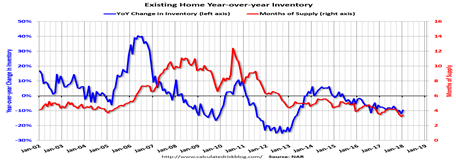
Total housing inventory at the end of January rose 4.1 percent to 1.52 million existing homes available for sale, but is still 9.5 percent lower than a year ago (1.68 million) and has fallen year-over-year for 32 consecutive months. Unsold inventory is at a 3.4-month supply at the current sales pace (3.6 months a year ago).

image

Graph: Calculated Risk

“Another month of solid price gains underlines this ongoing trend of strong demand and weak supply. The underproduction of single-family homes over the last decade has played a predominant role in the current inventory crisis that is weighing on affordability,” said Yun. “However, there’s hope that the tide is finally turning. There was a nice jump in new home construction in January and homebuilder confidence is high. These two factors will hopefully lay the foundation for the building industry to meaningfully ramp up production as this year progresses.”

First-time homebuyers are being squeezed because of the housing shortage, as just 29 percent were buyers, down from 32 percent last month.

The median existing-home price for all housing types in January was $240,500, up 5.8 percent from January 2017 ($227,300). January’s price increase marks the 71st straight month of year-over-year gains, according to the NAR.

New-home sales and construction are beginning to catch up with demand, but interest rates have to remain at their historic lows for this to continue. The 30-year fixed conforming rate is still 4.0 percent for 1 origination point, just 0.50 percent above its historic low. And several Federal Reserve Governors have said the Fed may not hike short term rates anytime soon, if inflation rates don’t move above the current 2 percent target rate.

Harlan Green © 2018

Follow Harlan Green on Twitter: https://twitter.com/HarlanGreen

Posted in Consumers, Housing, housing market, Weekly Financial News | Tagged , , , , | Leave a comment

Who Is Killing Our Children?

Popular Economics Weekly

The fact that the NRA contributed $30 million to Donald Trump’s campaign is all we need to know about who is responsible for deaths of 14 high school children and 3 adults in Florida, or the 58 killed and 851 wounded in Las Vegas.

What made the NRA the killing machine it has become, from the sporting association it once was? The NRA contributed a total of $55 million to 2016 presidential campaigns.

We can thank the Second Amendment of our Constitution that enshrined gun ownership as an unalienable right, and to Supreme Court Justice Antonin Scalia, who wrote the 2008 opinion in District of Columbia v. Heller that interpreted its original wording: “A well-regulated Militia, being necessary to the security of a free State, the right of the people to keep and bear Arms, shall not be infringed.” to mean every individual has the right to bear arms. But he added, that does not prevent the state from banning “dangerous and unusual weapons.”

We can also thank the gun manufacturers themselves that fund the lobbyists that keep Republican congressmen opposing all forms of gun control. We really should be talking about gun safety, rather than gun control, since gun owners aren’t required to have a license or training to own a gun, as is required for operators of other dangerous machines, like car owners.

We also know the carnage that guns can wreak. In 2016 alone there were more than 38,000 gun-related deaths, according to the Center for Disease Control. Just-released autopsy reports from the Las Vegas carnage show the damage done by military-style assault rifles at the Route 91 Harvest country music festival.

A military-style assault rifle bullet travels 3,000 feet per second—more than 3 times the speed of a pistol bullet because it is meant to kill instantaneously. It has such power that many bodies of the Las Vegas victims were literally torn apart by bullets that were probably tumbling by the time they reached the victims more than 500 yards away from Stephen Paddock, the Mandalay Bay Hotel’s 32nd story shooter.

image

Graph: Mother Jones

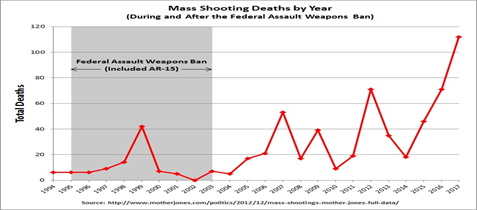
Military-style assault rifles have been banned before; during the Tommy gun era of 1930’s gangster wars, and in 1994 after a series of similar mass shootings with semi-automatic weapons. But it had a ten-year sunset clause that was never renewed when Republicans again dominated Congress.

There have been 1600 mass shootings since the 2012 Sandy Hook massacre of elementary school children, according to Maureen Dowd.

When will American children again feel protected? When a Congress is elected that admits military-style, semi-automatic guns of all shapes and sizes are “dangerous and unusual weapons” needed only by those trained to use them—the police and members of our military.

Harlan Green © 2018

Follow Harlan Green on Twitter: https://twitter.com/HarlanGreen

Posted in Politics, Uncategorized | Tagged , , , | Leave a comment