
Financial FAQs
“Real gross domestic product (GDP) increased at an annual rate of 1.6 percent in the first quarter of 2026 (January, February, and March), according to the second estimate released today by the U.S. Bureau of Economic Analysis. Real GDP was revised down 0.4 percentage point from the advance estimate, primarily reflecting downward revisions to investment and consumer spending.” BEA.gov
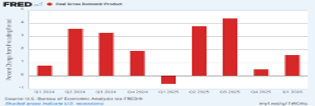
Economic growth this year is improving because corporations are making record profits—up 17 percent annually in Q1 2026 from an average 13 percent since the COVID-19 pandemic.
But it looks like much of the growth may be part of the tech bubble—such as massive overinvestments in chips and artificial intelligence (AI)—creating a bubble which by definition and past history will eventually deflate.
Why the sudden jump in corporate profits to 17 percent? It’s mostly from investing in the massive buildout of artificial intelligence centers and the infrastructure. How long can such GDP growth continue, especially if those future investments, such as in AI programs or the chips that power AI, may take years to turn a profit?
Republicans’ Big Beautiful Tax Cut Bill encouraged corporations to invest as much as possible this year because they could write it off in the same year, and those investments are generating serious profits in the buildout of AI data centers, for starters.
But the Biden administration’s $5trillion in investments to modernize the American economy—the CHIPS, Infrastructure, and Inflation Reduction Acts—are also contributing to the surge in growth.
Yet largely because of the Trump Administration’s mismanagement; even attempts to cancel or impede many of the Biden administration programs that would actually improve inflation, healthcare, environmental protection, and bring the manufacture of computer chips home; we are seeing those profits going into irrationally exuberant, overinvestment in future technologies with uncertain futures instead that is pushing major stocks and market indexes to record highs.
The announcements on the possibilities of AI are mind boggling. Zack Kass, Open AI pioneer and author of bestseller, The Next RENAISSANCE: AI and the Expansion of Human Potential, has said:
“If directed wisely, it will secure our needs, accelerate discoveries that serve human flourishing and unlike the products that commoditize our attention today, free us to invest in connections creativity and love.”
It will free whom, and what will they do then? It is causing massive layoffs at the likes of Amazon (30,000 employees to date) who hope that programs like Claude and ChatGPT can do much of the thinking and future planning for these corporations.
Consumers aren’t doing so well that actually make up most of the GDP growth equation. Their so-called Disposable Income (an economic term) declined to “slightly less than -0.1%” in April.
It resulted in a lowering of the personal savings rate to almost 2%, one-half of its more normal 3-4 percent rate in recent years. Consumers are stretched in other words; more than half of their incomes are now spent on the soaring costs of gasoline/energy products, household necessities, and food. This is another reason we may see slowing GDP growth ahead.
There is no question that AI has enormous potential for good, in what British economist JM Keynes made in a famous prediction in 1930, should there not be too many bumps in the promised road to a greater freedom from work:
“Thus for the first time since his creation man will be faced with his real, his permanent problem-how to use his freedom from pressing economic cares, how to occupy the leisure, which science and compound interest will have won for him, to live wisely and agreeably and well.” JM Keynes
But Keynes said this in 1930. How long has it been since then?
Harlan Green © 2026
Follow Harlan Green on Twitter: https://twitter.com/HarlanGreen


