
A Poor Employment Report?

Popular Economics Weekly

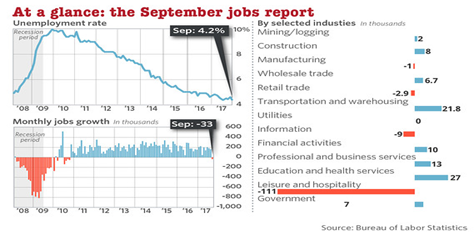
What does it mean when 33,000 nonfarm payroll jobs were lost in September? Not much, when many of the losses came from the hurricanes that threw 1.5 million out of work, according to Marketwatch’s Jeff Bartash, and the rest of our economy is doing very well.

Wages jumped, also good news, but it was mainly because many of those lost jobs were in retail and restaurants which tend to pay the lowest incomes, hence the upward trend may be temporary.
image

Graph: Marketwatch.com

The number of employed jumped by a huge 906,000 in the smaller household survey that determines the unemployment rate—in spite of the storms—while the number of job losses was smaller; at 331,000, hence the lower unemployment rate. So the rest of the U.S. is doing well.

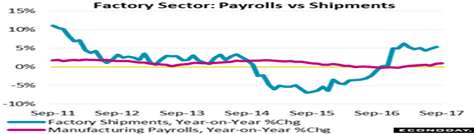
And we now have a fast growing manufacturing sector that will grow even faster with the cleanup and rebuild from those disasters. Its growth is also helped by the cheaper dollar, which is boosting exports.

Econoday reports ISM’s manufacturing index, already running well beyond strength in factory data out of Washington, is accelerating even further, to an index of 60.8 in September which is a 13-year best. Part of the gain in the index is tied to hurricanes and specifically deliveries times where slowing is translated as strength, as we said.

But it’s more than that—maybe those higher exports are boosting GDP growth as well? Factory new orders rose 4.3 points in the month to 64.6 which is a 4-year high. And the hurricanes didn’t slow down production which is at a very strong 62.2. Employment is a big standout in today’s report, posting the first 60 score at 60.3 in 6-1/2 years.
image

Graph: Econoday

The ‘other’ non-manufacturing service sector part of the economy is also growing robustly. The headline ISM non-manufacturing survey index jumped to 59.8 for the highest score in more than 3 years. New orders, that include strength for exports, jumped nearly 5 points to a robust 61.3 level that was last exceeded in April this year. Backlog orders jumped 2.5 points to 56.0 which helped employment rise 6 tenths to 56.8 with both these readings the strongest since May this year.

So the U.S. economy is firing on all cylinders, which is why the Fed is making louder noises re a December rate hike, in spite of nonexistent inflation. Why do so? Because it wants to gradually sell off its $4.5 billion hoard of government securities, which reverses the various QE programs that injected that much cash to boost growth.

So with less cash in circulation, money is no longer so cheap and market interest rates tend to rise. The Fed wants to be able to anticipate this trend.

But shouldn’t we be seeing more indications of higher growth than just one quarter of 3.1 percent GDP growth? That may happen if more federal funding than a measly $14.6 billion is available for Hurricane Harvey alone, when cleanup may cost $200 billion

Government-is-the-problem Texas Gov. Greg Abbott has changed his tune now that Texas is in need of federal funding. He said he thinks the state will need “far in excess” of $125 billion in federal relief dollars. Houston Rep. Sheila Jackson Lee called for a record-breaking $150 billion aid package on CNN recently.

Really, and who knows what Florida and Puerto Rico’s cleanup will cost? In fact, it will take such large amounts of federal spending to even sustain last quarter’s 3.1 percent growth rate, in my opinion.

Harlan Green © 2017

Follow Harlan Green on Twitter: https://twitter.com/HarlanGreen
Posted in Consumers, Economy, Politics, Weekly Financial News | Tagged , , , , , | Leave a comment

Time to Build More Homes!

The Mortgage Corner

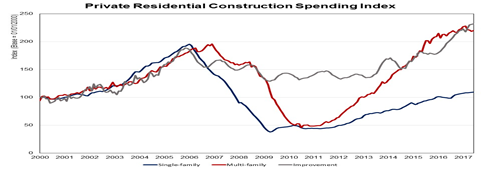
The National Association of Home Builders (NAHB) analysis of Census Construction Spending data shows that total private residential construction spending is soaring, as it rose to a seasonally adjusted annual rate (SAAR) of $520.9 billion in August, 0.5 percent up from downwardly revised July estimates.

But that’s not enough housing to satisfy current demand. There will be plenty of housing to replace, however, after this hurricane season has devastated so many U.S. states and territories.

image

Graph: NAHB.org

It was the fourth consecutive monthly increase after a dip in April, said the NAHB, Hurricane Harvey that made landfall late in August did not have significant impacts on construction spending in the same month, but will have a huge impact in months to come, as I said. The total private residential construction spending was 11.7 percent higher than a year ago. However, the blue line in the graph that represents residential construction spending still lags far behind commercial (red) and home improvement construction (gray lines).

The Midwest region is currently hurting the most from a housing shortage. Marketwatch’s Andrea Riquier reports the Home Affordability Index from real estate data provider Attom Data Solutions edged down to 100 in the third quarter, the lowest level since the third quarter of 2008, which was just as the financial crisis was taking hold.

Affordability is a problem because incomes haven’t risen as much as housing prices (especially in the Midwest). Attom notes that median home prices have risen 73 percent since bottoming out in 2012, while average weekly wages have increased only 13 percent in that time.

Why such a housing shortage so late in this recovery? For starters, the number of existing-homes listed for sale in 2017 to date is the lowest since 1999, according to the NAR. That’s in part because distressed sales volumes have fallen from more than 100,000 a month at the peak of the post crisis period, 2009-2012, to about 25,000 today, which means there aren’t many cheaply-priced homes left over from the housing crash.

And the construction industry because of a labor shortage has yet to catch up to soaring demand from a fully employed economy. More than half of the 3.5 million construction workers were laid off during the recession, and replacements are hard to find in this now fully employed economy.

Harlan Green © 2017

Follow Harlan Green on Twitter: https://twitter.com/HarlanGreen

Posted in Consumers, Housing, housing market, Weekly Financial News | Tagged , , , , , | Leave a comment

It’s Time For 2018

Financial FAQs

We will need the 2018 elections now more than ever to vote out the greed and cowardice of those members of our national legislature who oppose all forms of gun control in the wake of the Las Vegas massacre of innocents.  It is those who have supported gun-rights groups that need to be replaced to protect Americans from such random acts of violence.

Gun-rights groups have allowed the killing of thousands of Americans in mass shootings over the past decade, including 521 mass shootings in just the last 477 days, according to New York Times columnist Frank Bruni.

That’s also because we have to vote out supporters of the largest terrorist organization in the U.S., the National Rifle Association, that opposes any controls on military-style weapons of mass destruction.

Yes, that’s right. Military weapons, such as the AK-47 developed by the Soviets because it was cheap to manufacture and easy to use, are responsible for more American deaths than ISIS; or any other terrorist organization that has killed maybe 15-20 Americans in all.  Yet we spend $billions trying to eliminate them, but nothing on eliminating American terrorism.

Instead those monies are donated to the candidates that support American anti-gun control organizations, such as the NRA. Ted Cruz and Marco Rubio were the top recipients of monies from organizations that oppose any form of gun control in 2016, reports Marketwatch — no surprise, since they both ran for president.

Cruz raked in $360,727 to lead the way, according to OpenSecrets.org. Just two years earlier, Cruz had collected $18,300 when he was the junior senator from Texas and lacked any significant influence in the Senate.

Third on the list of recipients of their largesse is House Speaker Paul Ryan, who said of the Las Vegas massacre, “this is not who we are”. Do we really believe him when he was the recipient of $171,977 from such organizations?

Who are we when President Trump, our elected President said, “You came through big for me, so I will come through big for you,” at the NRA’s latest convention?

image

Graph: Marketwatch.com

That is in fact “who we are” at the moment, but not who we can become if we will take on such American terrorist organizations as the NRA that are responsible for the indiscriminate killing of so many women and children.

The big lie broadcast by gun-rights groups is that banning military-style weapons is banning the Second Amendment right to bear arms. No, that right is protected by the Second Amendment, but not the right to bear arms that slaughter so many innocents.

Harlan Green © 2017

Follow Harlan Green on Twitter: https://twitter.com/HarlanGreen

Posted in Uncategorized | Tagged , , , , , | Leave a comment

It’s Time For 2018

Financial FAQs

We will need the 2018 elections now more than ever to vote out the greed and cowardice of those members of our national legislature who oppose all forms of gun control in the wake of the Las Vegas massacre of innocents.  It is those who have supported gun-rights groups that need to be replaced to protect Americans from such random acts of violence.

Gun-rights groups have allowed the killing of thousands of Americans in mass shootings over the past decade, including 521 mass shootings in just the last 477 days, according to New York Times columnist Frank Bruni.

That’s also because we have to vote out supporters of the largest terrorist organization in the U.S., the National Rifle Association, that opposes any controls on military-style weapons of mass destruction.

Yes, that’s right. Military weapons, such as the AK-47 developed by the Soviets because it was cheap to manufacture and easy to use, are responsible for more American deaths than ISIS; or any other terrorist organization that has killed maybe 15-20 Americans in all, yet we spend $billions trying to eliminate them, but nothing on eliminating American terrorism.

Instead those monies are donated to the candidates that support American anti-gun control organizations, such as the NRA. Ted Cruz and Marco Rubio were the top recipients of monies from organizations that oppose any form of gun control in 2016, reports Marketwatch — no surprise, since they both ran for president.

Cruz raked in $360,727 to lead the way, according to OpenSecrets.org. Just two years earlier, Cruz had collected $18,300 when he was the junior senator from Texas and lacked any significant influence in the Senate.

Third on the list of recipients of their largesse is House Speaker Paul Ryan, who said of the Las Vegas massacre, “this is not who we are”. Do we really believe him when he was the recipient of $171,977 from such organizations?

Who are we when, when President Trump, our elected President said, “You came through big for me, so I will come through big for you,” at the NRA’s latest convention?

image

Graph: Marketwatch.com

That is in fact “who we are” at the moment, but not who we can become if we will take on such American terrorist organizations such as the NRA that are responsible for the indiscriminate killing of so many women and children.

The big lie broadcast by gun-rights groups is that banning military-style weapons is banning the Second Amendment right to bear arms. No, that right is protected by the Second Amendment, but not the right to bear arms that slaughter so many innocents.

Harlan Green © 2017

Follow Harlan Green on Twitter: https://twitter.com/HarlanGreen

Posted in Politics, Uncategorized | Tagged , , , , , | Leave a comment

Guns Kill People—Really!

Popular Economics Weekly

“Guns don’t kill people, people kill people” has been the credo of the NRA, gun lobby and most Republicans since the 1980s when gun manufacturers came up with automatic pistols, so that guns could kill more people.

59d3ca7e2d00002b003086fc

But Las Vegas shooter Stephen Paddock had no discernable mental illness, criminal record—or anger problems, according to his brothers. The NRA will try in vain to find a reason this inhuman act was committed when there is no reason, other than the fact that semi-automatic military-style weapons are legal in much of America and easily obtainable.

Only guns can kill that many people—including women and children. His brothers didn’t even know he was a gun nut who owned more than 30 weapons, and was able to smuggle in 10 suitcases containing 23 of those weapons without any Mandalay Bay staff even noticing such an oddity. Who needs that many suitcases in a hotel room?

The odds are that nothing will be done about this massacre, as long as President Trump and Republicans are in power. President Trump called it an act of evil, yet he won’t look at the evil in his own soul; the countless times he has lied and cheated to build his real estate empire that have been documented in many of the 3,500 lawsuits he has been involved in.

Australia had a similar gun problem until 36 people were killed in Port Arthur, and Prime Minister John Howard was able to pass strict gun control laws in 1996, the same year of Port Arthur of the Port Arthur massacre. There hasn’t been a mass killing since then in Australia.

Australians apparently don’t believe owning an assault rifle is the ticket to manhood. Their gun control laws are maintained by weapon buyback programs and the requirement that gun owners must belong to a certified gun club.

How did our gun laws become so lax that military-style weapons are easy to obtain? It was a little known Supreme Court decision authored by its most extreme ideologue, Justice Antonin Scalia in the 1980s, which said that gun owners no longer must heed the constitutional Second Amendment stricture that gun owners are members of a well-regulated militia in order to bear arms.

Our founding fathers must have thought it would help to curb the random gun violence we have today.

Harlan Green © 2017

Follow Harlan Green on Twitter: https://twitter.com/HarlanGreen
Posted in Politics, Uncategorized | Tagged , , , , | Leave a comment

Who Needs a Tax Cut?

Popular Economics Weekly

It turns out very few of us need a tax cut. Marketwatch economist Rex Nutting calculates that those in the 60 percent middle-income brackets—from $32,000 to $140,000 per year—pay just an average 2.5 percent in income taxes. It’s only the richest 0.1 to 1 percent income earners that pay more, and so want the huge tax cuts congress and the Trump administration are proposing.

  image

Graph: Marketwatch

Their rationale? That it will boost GDP growth to 3 percent from the current 2 percent average since the end of the Great Recession. But guess what? Q2 GDP growth was already 3 percent in Q2 and just revised to 3.1 percent, the highest growth rate in 2 years. Businesses are already investing in expansion—business investment in structures rose a stronger 7 percent instead of 6.2 percent in the revision. So, why not pay down the huge budget deficits accumulated since then, instead of cutting tax revenues?

“A bill that cuts federal income taxes for middle-class families makes absolutely no sense, except as a sad way of camouflaging the real intent of the bill: Giving millions of dollars to the very wealthy, who happen to be the only people who are really benefiting from our uneven economic growth,” said Nutting.

image

Graph: Econoday

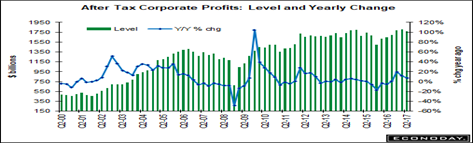
Top this off with another record for corporate profits, up 7.4 percent in a year, and there is no reason to be cutting corporate taxes. They haven’t been using their profits for productive purposes, so what’s needed is for them to pay higher taxes so government can use that money to invest productively in the $2 trillion plus in outmoded infrastructure that badly needs replacement.

As a bonus, any such investments in new airports, power grids, better water treatment facilities (such as Detroit’s), alternative energies, roads, bridges—you name it—will increase labor productivity that has been cut in half since 2000.

And increasing labor productivity is the only real ticket to higher economic growth, and increasing the take-home pay for those middle-income wage earners.

Harlan Green © 2017

Follow Harlan Green on Twitter: https://twitter.com/HarlanGreen
Posted in Consumers, Economy, Keynesian economics, Politics, Weekly Financial News | Tagged , , , , | Leave a comment

Tightening Credit = Bad Economic News (Revised)

Popular Economics Weekly

When is the next financial crisis? A Deutsche Bank study predicts it could be sooner than we know, as I said last week. Because the Federal Reserve reiterated its intent to begin to sell off the $4.5 trillion in excess reserves at its latest FOMC meeting at a time of record deficits built up to recover from the Great Recession.

“When looking for the next financial crisis, it’s hard to escape from the fact that we’re seemingly in the early stages of the ‘great unwind’ of global monetary stimulus at the same time as global debt remains at all-time highs following an increase over the past decade—at the government level at least—which has been unparalleled in peacetime history,” wrote Deutsche Bank strategists led by Jim Reid in an 88-page study entitled, “The Next Financial Crisis,” and cited by Marketwatch.

We haven’t fully recovered from the Great Recession, in other words, or the record deficit would have been paid down by now. So, this is the wrong time to be tightening credit. Instead, we should be raising taxes on those that have profited from the recovery—the top 1 percent that have garnered 96 percent of all income generated since the end of the Great Recession—as well as corporations with their record profits.

We really don’t need tax cuts, but pay raises for the majority of our workforce that hasn’t benefited from the recovery, if we want to boost economic growth; which is another way to pay down the deficit. Marketwatch reported on a recent employee survey that tells us exactly why personal incomes haven’t grown along with corporate profits that are the highest in history as a percentage of GDP.

“Pay raises for U.S. employees are not expected to improve next year, according to a survey released Monday by global professional services company Aon, based on a survey of over 1,000 companies. Base pay is expected to rise 3 percent in 2018, up slightly from 2.9 percent in 2017. Spending on variable pay — incentives or bonuses — will be 12.5 percent of payroll, low levels not seen since 2013. This suggests a “pessimistic view of corporate performance in the coming year,” Ken Abosch, a strategy and development analyst at Aon, said in a statement.

So where have all the profits gone that were generated since 2009? Executive Pay Watch, in a report conducted by the American Federation of Labor and Congress of Industrial Organizations (AFL-CIO), said last year CEOs were paid 335 times the average worker. The average production and non-supervisory worker earned $37,600 annually in 2016. “When adjusted for inflation, the average wage has remained stagnant for 50 years,” the report said.

That’s not a formula that will pay down the $10 trillion accumulated since the end of the Great Recession. The conundrum is why so much debt was issued with so little economic growth, and the US at near full employment?

It’s mainly because corporations have been able to successfully resist their employees’ demands for higher wages due to their monopoly positions in many industries, and massive lobbies. Instead they’ve used most of those profits to buy back their stock, and so enhance their earnings. CEO pay spiked 19.6 percent last year, before inflation.

The median total compensation for CEOs at S&P 500 companies totaled $11.5 million last year, an 8.5percent increase from the previous year and the largest increase since 2013, according to a joint report by the Associated Press and the executive pay data firm Equilar released earlier this year. 

So, we could be seeing a growth slowdown next year, or worse, unless we can reverse the huge redistribution of wealth that has occurred since 2009. But that would mean raising the nationwide minimum wage from its current $7.25/hour, last set in the 1990s, for starters.

And, then stopping the Trump administration and Republican congress from cutting taxes of the already wealthy, and cutting spending that supports the poorest and elderly in the new tax and budget proposals.

Their most blatant attempt to hurt those in most need has been the repeated attempts to repeal Obamacare (another tax cut for them). Otherwise, all that stimulus has gone for naught, and we could see this Great Recession turn into another Great Depression.

Harlan Green © 2017

Follow Harlan Green on Twitter: https://twitter.com/HarlanGreen
Posted in Economy, Macro Economics, Politics, Weekly Financial News | Tagged , , , , , , | Leave a comment

Bad News for Workers = Bad Economic News!

Popular Economics Weekly

Personal incomes have been increasing just 2.5 percent on average for several years. The problem is that’s not adequate GDP growth to pay down the $10 trillion in worldwide debt that’s been issued since 2008 to get us out of the Great Recession.

So where have all the profits gone that were generated since then for corporate execs and their stockholders? Executive Pay Watch, in a report conducted by the American Federation of Labor and Congress of Industrial Organizations (AFL-CIO). Last year, CEOs were paid 335 times the average worker. The average production and non-supervisory worker earned $37,600 annually in 2016. “When adjusted for inflation, the average wage has remained stagnant for 50 years,” the report said.

That’s not a formula that will pay down the $10 trillion accumulated since 2009, the end of the Great Recession. The conundrum is why so much debt with so little economic growth, and the US at near full employment?

And, with the Federal Reserve finally becoming serious about selling some of its $4.5 billion hoard of excess reserves, we could see a serious slump in economic growth coming.

“When looking for the next financial crisis, it’s hard to escape from the fact that we’re seemingly in the early stages of the ‘great unwind’ of global monetary stimulus at the same time as global debt remains at all-time highs following an increase over the past decade—at the government level at least—which has been unparalleled in peacetime history,” wrote Deutsche Bank strategists led by Jim Reid in an 88-page study entitled, “The Next Financial Crisis,” and cited by Marketwatch.

Why? Interest rates will finally begin to rise (i.e., less money in circulation), and less money also means credit tightening when weak household income growth has already stretched budgets.

A recent employer survey tells us exactly why personal incomes haven’t grown with corporate profits; still at record levels as a percentage of GDP. Corporations have been able to successfully resist their employees’ demands for higher wages. The top 1 percent have garnered 96 percent of all income generated since the Great Recession, since most of their profits have come from printed central bank money. It has enriched the banks and Wall Street, in other words.

Marketwatch reported on the Aon survey, recently: “Pay raises for U.S. employees are not expected to improve next year, according to a survey released Monday by global professional services company Aon, based on a survey of over 1,000 companies. Base pay is expected to rise 3 percent in 2018, up slightly from 2.9% in 2017. Spending on variable pay — incentives or bonuses — will be 12.5 percent of payroll, low levels not seen since 2013. This suggests a “pessimistic view of corporate performance in the coming year,” Ken Abosch, a strategy and development analyst at Aon, said in a statement.

Ah, but not for the CEOs of these companies that have used most of those profits to buy back their stock, and so enhance their earnings. CEO pay spiked 19.6 percent last year, before inflation.

The median total compensation for CEOs at S&P 500 companies totaled $11.5 million last year, an 8.5percent increase from the previous year and the largest increase since 2013, according to a joint report by the Associated Press and the executive pay data firm Equilar released earlier this year. 

So, we could be seeing a growth slowdown next year, or worse, unless we can reverse the huge redistribution of wealth that has occurred since 2009. But that would mean raising the nationwide minimum wage from its current $7.25/hour, last set in the 1990s, for starters.

And, then stopping the Trump administration and Republican congress from cutting taxes of the already wealthy, and cutting spending that supports the poorest and elderly in the new tax and budget proposals.

Their most blatant attempt to hurt those in most need has been the repeated attempts to repeal Obamacare (another tax cut for them). Otherwise, all that stimulus has gone for naught, and we could see this Great Recession turn into another Great Depression.

Harlan Green © 2017

Follow Harlan Green on Twitter: https://twitter.com/HarlanGreen

Posted in Consumers, Economy, Keynesian economics, Politics, Weekly Financial News | Tagged , , , | Leave a comment

Factory Orders, Business Investment Rising at the Right Time

Popular Economics Weekly

The US Dollar’s decline against foreign currencies, mostly due to geopolitical worries such as N. Korea’s nuclear intentions, is already helping the manufacturing sector with a sharp rise in factory orders. This will be aided by Hurricanes Harvey and Irma’s boost in capital expenditures as major infrastructure upgrades will be necessary.

Any infrastructure improvements—such as roads, bridges, the power grid, water and sewer plants—enhances efficiency and job formation. It seems force majeure, or unavoidable catastrophes, are the only way our political parties seem to be able to agree on doing anything that boosts growth!

image

Graph Econoday

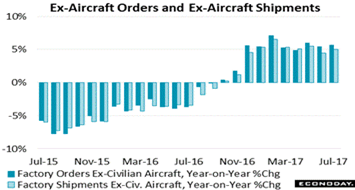
The factory sector has been slowly moving higher this year. Strength in aircraft has been a big plus but there are huge swings in monthly data. So the above graph excludes civilian aircraft and tracks both orders and shipments for all other manufactured goods. The story is one of recovery with growth moving to the solid 5 to 6 percent range after a long run of contraction tied to the 2014 collapse in oil.

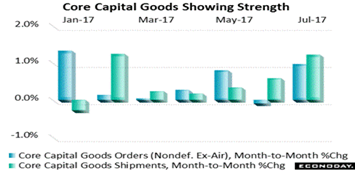
The best factory news has been coming from the most critical area: core capital goods where strength reflects rising investment in future production. Orders have been strong two of the last three reports, up 1.0 percent in July and 0.8 percent in May. This will boost shipments over the next few months which are already on the rise, up 1.2 percent after June’s 0.6 percent gain. An upswing in capital goods is auspicious for the factory sector which itself is considered a leading indicator for the economy as a whole.

image

Graph: Econoday

For all the damage they cause, these hurricanes will spur a gigantic rebuilding effort—maybe upwards of $200 billion in overall spending just to replace what was destroyed. That is 1/5 of President Trump’s original infrastructure proposal.

We have to start somewhere when our government can’t otherwise agree to rebuild our badly aging plants and equipment. The latest Job Openings and Labor Turnover Survey (JOLTS) report out today said there are 6.173 million job openings, and 5.5 million hires in August.

It is possible small business hires will pick up, as the National Federation of Independent Businesses Optimism Index rose 0.1 points in August to 105.3, matching the highest level since the 12-year high set in January. August’s optimism reflected increases in the proportion of small business owners planning capital expenditures and anticipating higher sales. Capital expenditures plans in the next 3 to 6 months reached their highest level since 2006, the NFIB said.

Now is the best time for these businesses (80 percent of hires are by small businesses) will try a little harder to hire more of those 6 million that are actually available and want to return to work.

Harlan Green © 2017

Follow Harlan Green on Twitter: https://twitter.com/HarlanGreen

Posted in Consumers, Economy, Weekly Financial News | Tagged , , , | Leave a comment

The Art of the Scam

Popular Economics Weekly

Did you have that queasy feeling; the ‘sick to your stomach’ feeling, when it was announced that Donald Trump was elected President of the United States?  I did. How could someone so obviously unqualified to be president of anything have done it?

It’s becoming more obvious by the day why that happened; why such a man could be elected our President; someone with a sordid business history who blatantly ignores facts, breaks the laws of the land, and ignores our constitution.

That’s because more has just been revealed about the automated Russian cyberattacks that detail how it was done.   These revelations conclude that Donald Trump’s election was a giant scam propagated by the Trump campaign with the aid of Russian intelligence and their propaganda machine.

The latest evidence points to son-in-law Jared Kushner as the main colluder, due to his supervision of the Trump campaign’s digital voter operation. McClatchy News first revealed the link between Kushner and Russia’s cyberwar.

“Congressional and Justice Department investigators are focusing on whether Trump’s campaign pointed Russian cyber operatives to certain voting jurisdictions in key states – areas where Trump’s digital team and Republican operatives were spotting unexpected weakness in voter support for Hillary Clinton,” according to McClatchy.

“By Election Day,” reported McClatchy in July, “an automated Kremlin cyberattack of unprecedented scale and sophistication had delivered critical and phony news about the Democratic presidential nominee to the Twitter and Facebook accounts of millions of voters. Some investigators suspect the Russians targeted voters in swing states, even in key precincts.”

Without Russian aid, Trump could never have vanquished his Republican opponents, as well. These cyberattacks were in play during the primary campaign against Republicans. Throughout the Republican primary elections in early 2016, Russia sent armies of bots carrying pro-Trump messages and deployed human “trolls” to comment in his favor on Internet stories and in social media, former FBI special agent Clint Watts told Congress weeks ago, according to McClatchy.

Perhaps this is why Facebook has finally admitted it sold at least $100,000 in paid advertising to Russian operatives in 2015-16 so that they could gain access to millions of Facebook subscribers.

Donald Trump perfected the Art of the Scam when building his business empire. Perhaps the best example was the Trump University scam—a university in name only—which he was forced to settle for $25 million last November shortly after winning the election. Presiding Judge Gonzalo Curiel had deemed it a criminal organization under RICO, and Trump was scheduled to testify at his trial when he settled with the thousands that  had been scammed, while raking in a reputed $5 million profit from unsuspecting students.

The best evidence that Trump knew he could not become President without Russia’s collusion, are his consequent actions in voicing support for every one of Putin’s policy initiatives—from lifting the Ukraine sanctions, repealing the Sergei Magnitsky Act, and even the breakup of NATO.

He has to be deathly afraid of what Putin could reveal of Trump’s sordid past and details of their collusion. Putin is blackmailing Trump, in a word. McClatchy News has provided the latest evidence of that collusion from confidential sources that the congressional intelligence committees and Special Investigator Robert Mueller are investigating.

So why does the Republican Party continue to support him?

Harlan Green © 2017

Follow Harlan Green on Twitter: https://twitter.com/HarlanGreen

Posted in Uncategorized | Tagged , , , , | Leave a comment