The Art of the Scam

Popular Economics Weekly

Did you have that queasy feeling; the ‘sick to your stomach’ feeling, when it was announced that Donald Trump was elected President of the United States?  I did. How could someone so obviously unqualified to be president of anything have done it?

It’s becoming more obvious by the day why that happened; why such a man could be elected our President; someone with a sordid business history who blatantly ignores facts, breaks the laws of the land, and ignores our constitution.

That’s because more has just been revealed about the automated Russian cyberattacks that detail how it was done.   These revelations conclude that Donald Trump’s election was a giant scam propagated by the Trump campaign with the aid of Russian intelligence and their propaganda machine.

The latest evidence points to son-in-law Jared Kushner as the main colluder, due to his supervision of the Trump campaign’s digital voter operation. McClatchy News first revealed the link between Kushner and Russia’s cyberwar.

“Congressional and Justice Department investigators are focusing on whether Trump’s campaign pointed Russian cyber operatives to certain voting jurisdictions in key states – areas where Trump’s digital team and Republican operatives were spotting unexpected weakness in voter support for Hillary Clinton,” according to McClatchy.

“By Election Day,” reported McClatchy in July, “an automated Kremlin cyberattack of unprecedented scale and sophistication had delivered critical and phony news about the Democratic presidential nominee to the Twitter and Facebook accounts of millions of voters. Some investigators suspect the Russians targeted voters in swing states, even in key precincts.”

Without Russian aid, Trump could never have vanquished his Republican opponents, as well. These cyberattacks were in play during the primary campaign against Republicans. Throughout the Republican primary elections in early 2016, Russia sent armies of bots carrying pro-Trump messages and deployed human “trolls” to comment in his favor on Internet stories and in social media, former FBI special agent Clint Watts told Congress weeks ago, according to McClatchy.

Perhaps this is why Facebook has finally admitted it sold at least $100,000 in paid advertising to Russian operatives in 2015-16 so that they could gain access to millions of Facebook subscribers.

Donald Trump perfected the Art of the Scam when building his business empire. Perhaps the best example was the Trump University scam—a university in name only—which he was forced to settle for $25 million last November shortly after winning the election. Presiding Judge Alfonso Curiel had deemed it a criminal organization under RICO, and Trump was scheduled to testify at his trial when he settled with the thousands that  had been scammed, while raking in a reputed $5 million profit from unsuspecting students.

The best evidence that Trump knew he could not become President without Russia’s collusion, are his consequent actions in voicing support for every one of Putin’s policy initiatives—from lifting the Ukraine sanctions, repealing the Sergei Magnitsky Act, and even the breakup of NATO.

He has to be deathly afraid of what Putin could reveal of Trump’s sordid past and details of their collusion. Putin is blackmailing Trump, in a word. McClatchy News has provided the latest evidence of that collusion from confidential sources that the congressional intelligence committees and Special Investigator Robert Mueller are investigating.

So why does the Republican Party continue to support him?

Harlan Green © 2017

Follow Harlan Green on Twitter: https://twitter.com/HarlanGreen
Posted in Politics, Uncategorized | Tagged , , , , | Leave a comment

Another Decent Employment Report

Financial FAQs

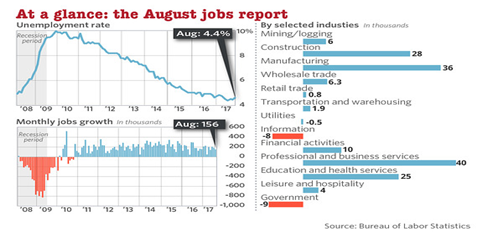
The Bureau of Labor Statistics reported that 156,000 additional nonfarm payroll jobs were created in August, which was less than expected, but will be enough to keep markets happy. And the unemployment rate edged up to 4.4 percent from July’s 4.3 percent as more workers began looking for work (77,000), but weren’t yet absorbed into the workforce. Almost all the job gains occurred in manufacturing, construction, professional and technical services, health care, and mining.

image

Graph: Marketwatch

A major positive in the report is a 36,000 surge in manufacturing payrolls that includes a 10,000 upward revision to July to a 26,000 increase and a 9,000 upgrade to June to a gain of 21,000. It’s a positive sign because manufacturing jobs pay higher wages.

Construction payrolls are also solid, up 28,000 in August following a 3,000 decline in July, which mirrors the surging housing market. The new-home construction rate is now above 1 million annual units.

But retail hiring has declined for six straight months as retail stores continue to close. This is while Amazon has announced plans to hire an additional 50,000 employees to work in its distribution centers.

This was a good jobs report, in other words, and suggests the ongoing recovery, now in its eighth year, shows no signs of weakening. Wages aren’t rising any faster than 2.5 percent; which is a mystery because manufacturing and construction jobs pay higher wages. Is that because there are still 5.6 million part time workers that would rather work fulltime? They earn less, so that may be what is holding down wage growth.

image

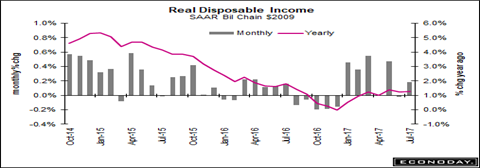
But real (inflation adjusted) Disposable Income is rising again after going negative in 2016.  Disposable income measures income from rents and the self-employed, as well as wages, which may give a boost to employees’ wages. It is the major reason consumer spending rose 3.3 percent in second quarter’s GDP report, and probably will boost third quarter growth as well. Wages and salaries have now risen 0.5 percent for two consecutive months.

The combination of good unemployment and rising incomes are boosting consumer confidence. The Conference Board reported on Tuesday that its consumer confidence index is now at 122.9, which is its highest value since December 2000.

“Consumer confidence increased in August following a moderate improvement in July,” said Lynn Franco, Director of Economic Indicators at The Conference Board. “Consumers’ more buoyant assessment of present-day conditions was the primary driver of the boost in confidence, with the Present Situation Index continuing to hover at a 16-year high (July 2001, 151.3). Consumers’ short-term expectations were relatively flat, though still optimistic, suggesting that they do not anticipate an acceleration in the pace of economic activity in the months ahead.”

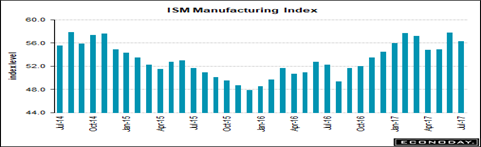
Manufacturing payrolls are surging in part because factory orders are rising again. Factory orders fell in July 3.3 percent because of a drop in aircraft orders, but there was a 6 tenths upward revision to core capital goods orders (nondefense ex-air) to a 1.0 percent gain and a 2 tenths upward revision to core shipments, now at 1.2 percent. These numbers point to accelerating strength for third-quarter business investment, which along with consumer spending are the main drivers of GDP growth.

Another boost to Q3 growth will be the recovery efforts for Hurricane Harvey. Damage estimates range up to $100 billion, and governments (as well as insurance) companies will be spending most of that money.  This is what governments need to do, even if the U.S. congress can’t pass a substantial infrastructure bill this year.

And what about the estimated 6 million damaged autos that will be replaced? That give’s another boost to the manufacturing sector, and Q3 economic growth!

Harlan Green © 2017

Follow Harlan Green on Twitter: https://twitter.com/HarlanGreen
Posted in Consumers, Economy, Macro Economics, Politics, Weekly Financial News | Tagged , , , | Leave a comment

Are Corporate Taxes Too Low?

Financial FAQs

As congress now pivots to the debate on tax reform—when and if they can agree on raising the debt ceiling—why is a lower corporate tax rate part of the proposal? The federal budget deficit can’t decline unless congress raises tax rates to 1970s level, when budget deficits were comparatively minuscule.

The total budget deficit in 1970 was $12.7 billion, or just 0.3 percent of GDP, vs. 3 percent and $580B today. The 1970 effective corporate tax rate on capital income was 42.0 percent, vs. 35 percent today. So any corporate tax cut will only grow the deficit.

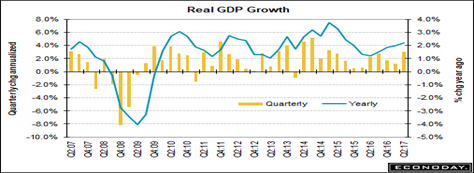
This is while corporate profits rose $73 billion in the revised Q2 GDP growth rate, up to 3 percent from Q1’s 2.1 percent rate. It was a good GDP number, as consumer spending increased 3.3 percent and business investment increased almost 9 percent with almost no inflation.

image 

Graph: Econoday

The proposed House bill wants to reduce the maximum corporate tax rate from 35 to 20 percent. But why, when as I said in a prior column, corporations already pay much less than the actual tax rate? Maybe this will change, but corporations have been using their record profits to buy back stock and enhance executive pay, rather than hire more workers, so that there are now 6 million job vacancies, according to the Commerce Department’s JOLTS report.

They have bought back to much stock that a Credit Suisse report released in March titled “The Incredible Shrinking Universe of U.S. Stocks,” says between 1996 and 2016, the number of publicly-listed stocks in the U.S. fell by roughly 50 percent — from more than 7,300 to fewer than 3,600 — while rising about 50 percent in other developed nations.

Not all of it is from stock buybacks, as there have been a large number of corporations either merging, or taken private in buyouts so that the number of listed companies has also declined almost 50 percent since 1996.

So why do corporations and their Republican lobbyists keep pushing for lower taxes? They say it will create more jobs. But, alas, that isn’t shown by the record. An excellent New York Times Op-ed by Sarah Anderson at the Institute for Policy Studies points out that many corporations create very view jobs with those profits.

She reports on 92 public-held American corporations between 2008-15 that pay less than 20 percent in taxes. They had a median job growth rate of 1 percent vs. 6 percent for all private sector corporations during that time.

And 48 of those companies actually cut 438,000 jobs, while their chief executives’ pay last year averaged nearly $15 million, compared with the $13 million average for S&P 500 companies.

So why not have congress push corporations to fill more of the 6 million job openings, which could expand their markets, increase profits and help to pay down our enormous public debt, rather than continue to fill their own pockets?

Harlan Green © 2017

Follow Harlan Green on Twitter: https://twitter.com/HarlanGreen
Graph: Econoday

Posted in Consumers, Economy, Politics, Weekly Financial News | Tagged , , , | Leave a comment

Cheaper Dollar Will Help Job Growth

Popular Economics Weekly

The U.S. Dollar is falling due to a number of factors. And this will boost the export of manufactured goods, as our goods will now be cheaper overseas. It will hurt imports, which become more expensive (even imported oil), but that’s a good thing because domestically produced consumer goods become cheaper, boosting domestic jobs.

The euro now costs $1.20, when it was almost 1:1 to the Dollar last fall. Is the Dollar decline due to the latest North Korean missile launch, or Hurricane Harvey? Time will tell, but the U.S. factory sector is now doing very well because of the cheaper dollar.

image

Graph: Econoday

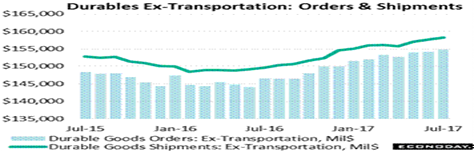
Durable goods orders of goods that last more than 3 years, such as autos and appliances, are booming since the Dollar’s decline and this will help GDP growth. The boost to exports is a plus for our balance of payments problem and the budget deficit.

image

Graph: Econoday

Consumer confidence to date isn’t being hurt by either North Korean saber rattling or the Charlotte riots, according to the Conference Board. The Conference Board Consumer Confidence Index®, which had increased in July, improved further in August. The Index now stands at 122.9 (1985=100), up from 120.0 in July, said their press release. The Present Situation Index increased from 145.4 to 151.2, while the Expectations Index rose marginally from 103.0 last month to 104.0.

“Consumer confidence increased in August following a moderate improvement in July,” said Lynn Franco, Director of Economic Indicators at The Conference Board. “Consumers’ more buoyant assessment of present-day conditions was the primary driver of the boost in confidence, with the Present Situation Index continuing to hover at a 16-year high (July 2001, 151.3). Consumers’ short-term expectations were relatively flat, though still optimistic, suggesting that they do not anticipate acceleration in the pace of economic activity in the months ahead.”

All in all, a continuation in the dollar’s decline will also be beneficial to manufacturing jobs, which tend to pay higher wages. And higher wages are needed to boost worker productivity and get us out of the slow growth syndrome the U.S. has been living through since the end of the Great Recession.

Harlan Green © 2017

Follow Harlan Green on Twitter: https://twitter.com/HarlanGreen
Posted in Consumers, Economy, Macro Economics, Weekly Financial News | Tagged , , , , | Leave a comment

Where Are the New Homes?

The Mortgage Corner

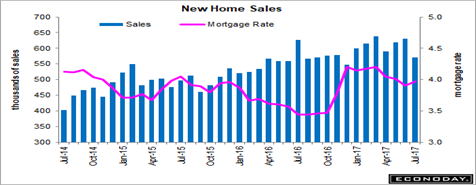
There is a surging demand for new home that builders find hard to meet.  New-home sales fell in July to 571,000 units, though May and June totals were revised upward. That’s because the Census Bureau estimate comes from a very small survey sample with plus or minus 11 percent possible deviation, hence the sometimes large revisions.  For instance, this is 9.4 percent (±12.9 percent) below the revised June rate of 630,000 and is 8.9 percent (±15.4 percent) below the July 2016 estimate of 627,000. And inventories can be uncertain with labor and lumber shortages.

The goods news this month is the available supply of new homes for sale rose sharply, up 4,000 to 276,000 new homes on the market. Relative to sales, supply moved from 5.2 months to 5.8 months, which is nearly at the 6-month mark, widely considered to be balanced for new homes, says Econoday.

So with more new homes coming on line, sales could jump again.

image

Graph: Econoday

This is while existing-home sales ran at a seasonally adjusted annual rate of 5.44 million, the National Association of Realtors said today. That was down 1.3 percent from a downwardly-revised June pace but 2.1 percent higher than a year ago. That’s because there aren’t enough home for sale, folks, with available supply down to 4.2 month. It was the lowest since last August.

“Homes are selling fast,” NAR Chief Economist Lawrence Yun said. In July, that strong demand meant listings went into contract in under 30 days. It also pushed prices higher. The median sales price in July was $258,300, a 6.2 percent increase compared to a year ago.

So all will depend on more homes being built, and housing starts are trending higher. Although nationwide housing starts fell 4.8 percent in July to a seasonally adjusted annual rate of 1.16 million units, according to data from the U.S. Department of Housing and Urban Development and the Commerce Department, year-to-date, single-family starts are 8.6 percent above their level over the same period last year.

Homebuilder’s optimism is also holding up. Builder confidence in the market for newly-built single-family homes rose four points in August to a level of 68 on the National Association of Home Builders/Wells Fargo Housing Market Index (HMI), said the NAHB.

“The fact that builder confidence has returned to the healthy levels we saw this spring is consistent with our forecast for a gradual strengthening in the housing market,” said NAHB Chief Economist Robert Dietz. “GDP growth improved in the second quarter, which helped sustain housing demand. However, builders continue to face supply-side challenges, such as lot and labor shortages and rising building material costs.”

image

Graph: Econoday

The number of housing permits for future construction is the main factor determining future new-home inventories. And housing permits have been a thorn in the economy’s side all year, bouncing up occasionally but diving more times than not, reports Econoday. Permits were a negative in the week, falling to a 1.223 million annualized rate for a 4.1 percent monthly decline.

Permits are a leading indicator for construction and the results are pointing to further flattening for residential spending. Yet there are more pluses than minuses in housing, evident in the yearly rate for permits, which, is up 4.1 percent, as much as July was down.

So, the overall housing market remains strong. And guess what, interest rates plunged again, so that the 30-year conforming fixed rate is again at 3.50 percent for a 1 point origination fee. With rates this low, and the Fed now saying it may hold off on another rate hike, we could see these rates hold for the rest of this year.

Where are the new homes? Regionally, new home sales increased 6.2 percent in the Midwest. Sales fell 4.1 percent in the South, 21.3 percent in the West and 23.8 percent in the Northeast.  The number of permits issued rose 19.2 percent in the Northeast, fell 1.4 percent in the South, 7.9 percent in the West, and 17.4 percent in the Midwest.

Harlan Green © 2017

Follow Harlan Green on Twitter: https://twitter.com/HarlanGreen
Posted in Consumers, Housing, housing market, Weekly Financial News | Tagged , , , , , , | Leave a comment

Where is Badly Needed Infrastructure Investment?

Financial FAQs

The all-Republican congress and Whitehouse are making a serious mistake in letting politics and ideology get in the way of economic growth. Does anyone seriously believe their attempts to repeal Obamacare would work with so many of their red state constituents dependent on Medicare?

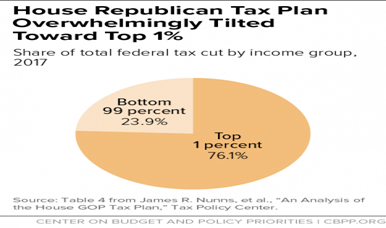
And now they want to tackle a regressive tax reform plan that, according to the Tax Policy Center analysis of their 2016 proposal, 76.1 percent of the net tax cuts would flow to the richest 1 percent of households in 2017.  And by 2025, essentially all of the net tax cuts — 99.6 percent — would go to the top 1 percent. That doesn’t even pass the smell test.

It’s really incredible that Republican leaders of both the House and Senate can’t see that Trump’s $1 trillion infrastructure proposal wouldn’t boost growth. That is the one item that would stir us out of the 2 percent growth doldrums.

However, we have to remember Republicans have always hated the idea of another New Deal, because it would bust their bubble that government investment can actually work, as it did to build our highways, Internet, shots to the Moon, educational system, a cleaner (and more productive) environment, and so forth.

President Trump’s infrastructure proposal would work, even if partially funded with $40 billion from Saudi Arabia and its allies. But Trump is now toxic with the business community after his Charlottesville racist fiasco. His 34 percent voter base, (or maybe now 24 percent in more recent polling) that continue to support him, even if he shoots someone on Fifth Avenue, won’t keep him in power, as he believes.

But higher economic growth would. Marketwatch economist Jeff Bartash has highlighted what it would take to take US out of the doldrums. “Lackluster business investment is one of the chief reasons the U.S. continues to bob along at about 2 percent annual growth, less than two-thirds the historic average. Investment is what spurs new inventions, makes it easier for workers to do their jobs and allows the economy to expand at a faster rate.”

“A souped-up economy in turn generates higher profits, fatter dividend payments and bigger paychecks for workers,” says Bartash. “Whatever hope businesses may have had earlier in the year, however, has been clouded by the failure of a flailing Trump White House to push through tax cuts, more spending on public works and other measures to aid big and small companies alike.”

President Trump is truly a foolish man to believe he can shoot anyone (including himself in the foot) and accomplish anything, if he won’t renounce neo-nazis, white racists and the Ku Klux Klan.

Harlan Green © 2017

Follow Harlan Green on Twitter: https://twitter.com/HarlanGreen
Posted in Economy, Keynesian economics, Politics, Weekly Financial News | Tagged , , , , | Leave a comment

Will There Be Tax Reform?

Popular Economics Weekly

After Republicans’ failure to repeal Obamacare, they will now attempt to pass a budget, and tax reform plan. But the $1 trillion in spending cuts (mainly from Medicare) they hoped with the repeal of Obamacare, which would go into tax cuts for corporate, capital gains and upper income personal tax brackets, probably won’t happen.

And that could be a good thing, if it focuses solely on enriching a few. Corporate taxes aren’t too high with all the loopholes that bring down the effective corporate tax rate to 13 percent, rather than the nominal 23.8 percent rate, while the maximum personal tax rate was 92 percent in the 1950s under President Eisenhower when the U.S. was building our modern productivity- enhancing infrastructure, which badly needs an upgrade. And corporations already have record corporate profits as a percentage of GDP, which most aren’t using to increase capital expenditures and so productivity (and growth).

Any attempt at tax reform will run into the moderates in a split Republican Party that want to maintain Medicare and other social programs that aid those in the poorest overwhelmingly Republican red states. So the moderates will stymie efforts to cut spending in social programs, which means that Repubs can’t cut taxes without creating a very large budget deficit—even larger than it is now.

Tax cuts matched with spending cuts have only increased the budget deficit under the various Republican plans. Whereas the Obama administration drastically reduced annual budget deficits while rescinding most of the Bush tax cuts. The formula worked. This raised most taxes back to Clinton administration levels, while maintaining the various social programs that benefited the poorest and disabled.

Corporations are not investing what they should and could because they prefer using financial engineering to finagle stock prices to enrich investors (and executives) while squeezing employees’ incomes that hurts their producitivity. 

Whereas public sector investment is so important when it gets spent on productivity-enhancing infrastructure upgrades. It becomes revenue neutral because it stimulates higher growth, just as it did in the last 4 years of the Clinton administration, which yielded actual budget surpluses.

So Republicans’ sole focus on spending and tax cuts is a mistake. The CBPP reports the House GOP agenda issued in 2016 a tax reform plan, which they haven’t amended, and that a 2016 Tax Policy Center (TPC) analysis shows would overwhelmingly benefit the highest-income households.  Under the plan, 76.1 percent of the net tax cuts would flow to the richest 1 percent of households in 2017.  And by 2025, essentially all of the net tax cuts — 99.6 percent — would go to the top 1 percent.

image

The figures are similarly striking for households with incomes over $1 million, who would reap 71.2 percent of the tax cuts in 2017 and 96.5 percent of the net tax cuts in 2025.[1]  The plan is actually more regressive and more heavily tilted toward those at the top of the income scale than past GOP tax cut proposals.

On the individual tax side, the new tax rate structure would have three brackets of 12 percent, 25 percent, and a top rate of 33 percent.  High-income people’s pass-through income — business income that’s claimed on individual tax returns — would be taxed at a special lower top rate of 25 percent. 

Evidence of the damage from corporations’ financial engineering (instead of productivity-enhancing investments) is the collapse in the number of listed companies. In a Credit Suisse report released in March titled “The Incredible Shrinking Universe of U.S. Stocks,” there were 7,322 in 1996; today there are 3,671. It is important not to confuse this with a shrinking of the stock market: the value of listed firms has risen from 105 percent of GDP in 1996 to 136 percent now. But a smaller number of older, bigger firms dominate bourses.

Consequently between 1996 and 2016, the number of publicly-listed stocks in the U.S. fell by roughly 50 percent — from more than 7,300 to fewer than 3,600 — while rising by about 50 percent in other developed nations, said Credit Suisse. 

A spike in M&A activity accounted for a rapid acceleration in delistings (and fewer stocks) as well. Private equity has been a dominant force. In 1980, PE deal volume slightly exceeded $1 billion. By 1996, that number had reached $80 billion. And today, it sits at a staggering $825 billion.

Though it’s an old (but time tested) proverb, when private enterprise won’t step up to save economic growth, government has to fill the void.  The best tax reform is that which invests in the future of American productivity, rather than Wall Street’s financial engineering.

Harlan Green © 2017

Follow Harlan Green on Twitter: https://twitter.com/HarlanGreen

Posted in Economy, Keynesian economics, Macro Economics, Weekly Financial News | Tagged , , , , , , , | Leave a comment

Retail Sales Back, But Not Consumers

The Mortgage Corner

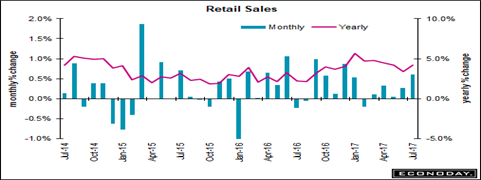
It turns out consumers decided to shop again in July, as retail sales surged in all categories. This includes online sales these days, as retailers adapt to the new reality that one large store size doesn’t fit all. But it may be a one-time surge, as wages are barely rising above inflation, and major brick and mortar stores are disappearing, while factory discount outlets thrive.

Nonstore retailers, vehicle dealers, building materials stores lead the report — all major categories. Secondary readings are all strong: up 0.5 percent ex-autos, up 0.5 percent ex-autos ex-gas, and up 0.6 percent for the control group. Annual sales had risen above 5 percent in January, then declined until this month. So it’s hard to know if consumers in fact feel more prosperous.

image

Graph: Econoday

Target, for instance is opening more than 100 ‘small-store’ outlets near universities and colleges that was announced at their second quarter earnings call. Target Chief Executive Brian Cornell said the retailer would be nearly doubling the number of small-format stores it has this year, with the ultimate goal of having more than 100 open for business over a three-year period. The plan is to have 30 in 2017, said Chief Operating Officer John Mulligan, with nine opening in July and four opening in the first quarter.

“While we’ve only been open a few weeks, our July openers have been particularly strong out of the gate and as Brian highlighted, the guest response has been phenomenal,” Mulligan said on the Wednesday call, according to a FactSet transcript. “For the seven smallest format stores that have been open for more than a year, we’re continuing to see sales productivity more than double the company average and these stores have been delivering high-single-digit comp increases so far in 2017.”

We reported earlier that most households aren’t earning enough income to do more than pay their bills, such is the current record income inequality. The monthly reading for this measure did finally show some life in the prior week’s employment report with an unadjusted 0.3 percent gain, but it will take a continued run of strength to level out the 2-year trend line which remains in a deep downslope, said Econoday.

So we remain doubtful this retail surge can continue given all the actual brick and mortar stores closed or about to close. Brokerage firm Credit Suisse said in a research report released earlier this month that it’s possible more than 8,600 brick-and-mortar stores will close their doors in 2017.

For comparison, the report says 2,056 stores closed down in 2016 and 5,077 were shuttered in 2015. The worst year on record is 2008, when 6,163 stores shut down.

Why? Is it only Amazon online shopping? No, because consumer incomes are barely rising, as I said, they look for discounts everywhere, and brick and mortar stores with their higher overhead, can’t cut prices as much, and can’t offer the variety that Amazon offers.

Now we hear that Amazon also wants to compete on the ground. What next? It will probably be more like an Apple store that samples its services and directs customers to its online warehouses, also springing up everywhere. Who can match that kind of cost-cutting when workers’ stagnant wages and salaries mean they will continue to discount shop for bargains.

Guess what is missing that would boost economic growth? Infrastructure spending, and now that Big Business has walked away from President Trump’s business councils, and is dissing Senate Republican leaders, good luck on getting anything done!

Harlan Green © 2017

Follow Harlan Green on Twitter: https://twitter.com/HarlanGreen
Posted in Consumers, Economy, Politics, Weekly Financial News | Tagged , , , | Leave a comment

Why the Greater Lawlessness?

Popular Economics Weekly

image

We knew as far back as Nixon’s Watergate that the Republican party harbors a lawless tendency when it suits them. Why else would President Reagan engineer the illicit Iran contra arms deal with the Ayatollah Khomeini, or, President GW Bush invade Iraq when UN inspectors already knew Saddam Hussein had destroyed his weapons of mass destruction a decade earlier?

The lawlessness of Republicans’ hunger for power has now reached such a point that they have selected and continue to support a president who has lied and cheated his whole adult life; from Trump Casinos to Trump Towers, from stiffing bankers and his workers to cooking the books. This has been documented in many of the 3,500 plus lawsuits Trump has been involved in, and the reason he settled the Trump University lawsuits, one of which alleged he ran a fraudulent enterprise under RICO, the Racketeer Influenced and Corrupt Organizations Act.

The sins of Hillary and Bill Clinton pale, yet Republicans impeached Bill for lying about a sexual encounter and continue to hound Hillary over lost emails. So why aren’t they impeaching Donald Trump who hasn’t divested himself of his assets to avoid conflicts of interest and continues to profit and even solicit favors from foreign governments in direct violation of the constitution?

His current 34 percent Gallup popularity rating is testimony that his support is now only restricted to those that would support him, even if, ““I could stand in the middle of Fifth Avenue and shoot somebody, and I wouldn’t lose any voters,” said at a January 2016 Iowa campaign rally.

And now we have President Trump condoning the lawlessness of his neo-nazi and white nationalist supporters holding a torchlight parade in Charlottesville, Virginia, Jefferson’s hometown.

CNN commentator David Gergen, advisor to four presidents, chastised Trump yesterday in commenting on the Charlottesville riot and death of a counter-demonstrator. “He said he wants to bring love, not hatred to the country,” Gergen said. “Good. We need to deal with hatred, but he needs to deal with the hatred in his own heart if he wants to bring more love to the country.”

When will the Republican party stand up to such blatant lawlessness? Only when they can deal with the lawlessness in their own hearts. In selecting an autocrat to further their agenda, they are in effect saying freedom means anarchy, rather than living within a democracy of laws based on the world’s first constitution that guarantees equal rights for all of its citizens.

Harlan Green © 2017

Follow Harlan Green on Twitter: https://twitter.com/HarlanGreen
Posted in Politics, Uncategorized | Tagged , , , , , | Leave a comment

What Happened to Rising Wages?

Popular Economics Weekly

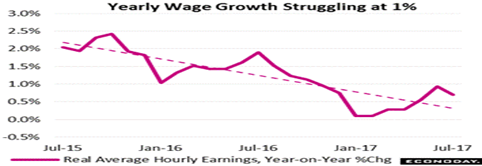
Everything should point to higher wages and salaries ahead for employees with a 4.3 percent unemployment rate and record corporate profits, but corporate profits go mainly to their executives and owners (and their stockholders) these days. The result is stagnant wages and household incomes.

image

Graph: Econoday

“Real”, or inflation adjusted average hourly earnings slipped 2 tenths in July to a year-on-year 0.7 percent. This reading has been under the 1 percent line since October last year. The monthly reading for this measure did finally show some life in the prior week’s employment report with an unadjusted 0.3 percent gain, but it will take a continued run of strength to level out the 2-year trend line which remains in a deep downslope, says Econoday.

It’s as if corporate bosses no longer are interested in maximizing their growth, which is the normal way to maximize profits. They have been successful in boosting profits, but mainly through financial engineering—that is, stock buybacks paid with borrowed money, or mergers and acquisitions that consolidate markets into fewer players.

This increases their monopoly powers to boost profits and resist employee calls for higher wages. It has helped to keep the stock market humming, but not the economic growth that should accompany such profits.

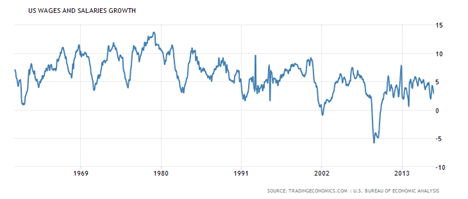
Wages in the United States increased 2.95 percent in May of 2017 over the same month in the previous year. But a better idea of healthy wage growth in the United States is a historical average of 6.26 percent from 1960 until 2017, reaching an all-time high of 13.77 percent in January of 1979 and a record low of -5.77 percent in March of 2009, according to Trading Economics.

image

Graph: Trading Economics

This is what normal wage growth should look like, if workers were earning a living wage, and inflation was rising at a normal rate. The inflation rate in the United States averaged 3.28 percent from 1914 until 2017, and was 14 percent in 1980. Wages since then have been suppressed in the name of suppressing inflation, as employees’ bargaining power has been curtailed.

That’s why the national minimum wage is still $7.25 per hour, last raised in 2009, though some cities and states are beginning to raise it to $15 per hour, which is what economists calculate is the minimum living wage for a family of four. And that is just enough to cover what a household has to pay for housing, gas, food, clothing, and other everyday items.

But it’s an uphill battle when business interests rule the markets with little push back or bargaining power held by 80 percent of the workforce that are wage earners, and we wonder why so many refuse to return to work. So we shouldn’t wonder why U.S. labor productivity, which ultimately sets our standard of living, has remained so low of late. It increased at an average annual 2.5 percent from 1948-2007, but just 1.2 percent from 2010-14.

It’s also the reason the U.S. have the highest income inequality in the developed world. The U.S. ranks 106th of the 149 countries in income inequality as ranked by the CIA’s World Factbook with a Gini inequality index of developing countries like Peru and Cameroon. 

Harlan Green © 2017

Follow Harlan Green on Twitter: https://twitter.com/HarlanGreen
Posted in Consumers, Economy, Macro Economics, Politics, Weekly Financial News | Tagged , , , , , , , | Leave a comment