More Job Openings, Fewer Hirings Mean What?

Popular Economics Weekly

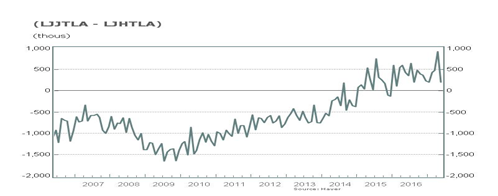
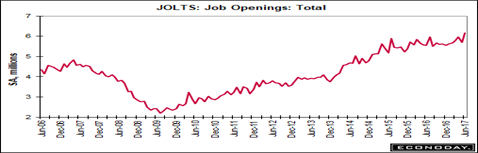
The job market continues to fluctuate, as job openings rose sharply in June to 6.163 million from 5.702 million in May. Hires, however, fell sharply, to 5.356 million from 5.459 million. This data set can be volatile but the underlying theme is a separation between openings and hiring, says Econoday, which rather than too full employment and higher inflation points to workers who refuse to return to work, unless employers will pay enough to entice them to return.

The number of unfilled jobs rose again to 807,000, whereas the unfilled total had fallen to 194,000 in May, and there were1 million openings the month before. See what I mean?
image

Graph: Econoday

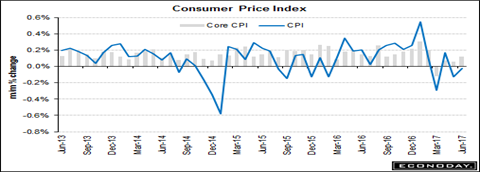
There is really no inflation to speak of, in fact the looming danger is disinflation (meaning falling inflation), which can lead to outright deflation and falling prices. Economists don’t like falling prices because it could lead to a recession.

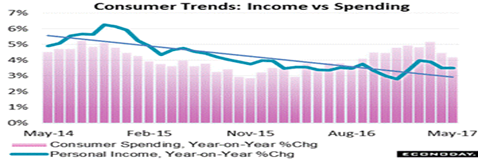
That hasn’t happened yet, but interest rates plunged again. The Fed’s preferred Personal Consumption index that measures overall prices is too low.
 

image

Graph: Econoday

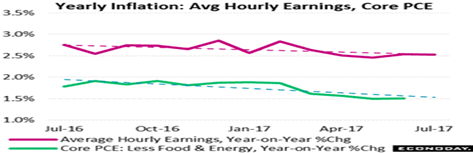
The main determinant of inflation is the cost of labor, which accounts for approximately two-thirds of labor costs. Though wages have risen slightly of late, it still can’t buck the 2.5 percent annual increase it’s been for years.

“At 4.3 percent unemployment, earnings in theory should be much higher, at least above 3 percent where many believe it needs to be before feeding into overall inflation,” said Econoday last week. “And overall inflation, tracked here by core PCE prices, hasn’t been moving higher either, dipping to the 1.5 percent line.”

That is the meaning of disinflation, and a reason the Federal Reserve will be hesitant to raise their rate another 0.25 percent in their September FOMC meeting. The Prime Rate that controls revolving debt, and even equity line mortgages has already risen from 3.50 to 4.25 percent.

This is while long term Treasury yields continue to drop. The 10-year Treasury yield is now 2.2 percent, which is why the conforming 30-yr fixed rate is still at 3.50 percent for a 1 pt. origination fee. This is what is called a declining yield curve, which means less profits for banks, since they borrow money at a short-term rate, and lend it at longer term rates.

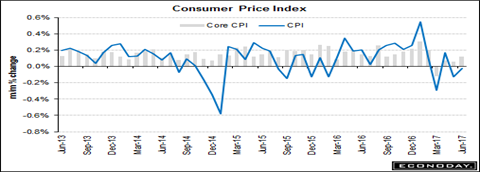
Consumer prices have risen an unadjusted 1.7 percent over the past 12 months, up slightly from 1.6 percent in June. But on a core basis (without food and energy price changes), which is watched more closely by Fed officials, consumer prices remained at a 1.7 percent annual rate, the same rate as in May and June.

So, we have all these job openings that far outnumber hirings, while consumers can’t or won’t push up prices because their incomes aren’t rising enough to boost product costs and so prices.

That is why there are so many unfilled jobs, and such low inflation. Producers would have to boost wages to attract more workers, and they haven’t done so to date. Why? It could be corporations are choosing to use record profits to overpay their executives and stockholders, in effect rewarding themselves, instead of growing their markets.

That is not what all corporations choose, of course, but we know the 7 million total of unemployed and part time workers that want to work fulltime hasn’t changed in a long time, according to the Labor Bureau—which is why economic growth is still stuck at 2 percent. Economists have yet to come up with a better answer, and many workers have answered such employers with their refusal to return to work.

Harlan Green © 2017

Follow Harlan Green on Twitter: https://twitter.com/HarlanGreen
Posted in Consumers, Economy, Weekly Financial News | Tagged , , , | Leave a comment

Another Great Jobs Report?

Financial FAQs

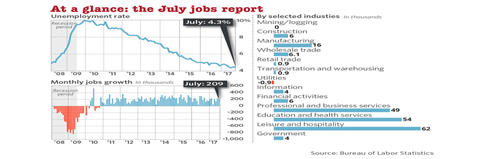
No economist predicted another 209,000 private payroll jobs would be created in July, or that the last 2 months’ total would be 431,000, or the y-t-d total would be 1,290,000 payroll jobs created this year.

But they should have. The May JOLTS report was an indicator of higher employment numbers, as the unfilled jobs total dropped to 194,000 from 1 million the month before, for a total of 5.472 million hirings in May.

image

Graph: Marketwatch/BLS

Job gains occurred in food services and drinking places, professional and business services, and health care. Employment growth has averaged 184,000 per month thus far this year, in line with the average monthly gain in 2016 (+187,000), said the Labor Bureau.

The only glitch, if that can be considered a problem, is that wages are still rising at 2.5 percent annually, which means two things. It means consumers won’t buy more than they are already buying, which would in turn increase demand and so increase economic growth, and there’s very little inflation, which means interest rates won’t be rising soon.

Wages aren’t rising faster because there are still many unemployed, or working part time when they would rather be working fulltime. “Both the unemployment rate, at 4.3 percent, and the number of unemployed persons, at 7.0 million, changed little in July. After declining earlier in the year, the unemployment rate has shown little movement in recent months,” said the BLS.

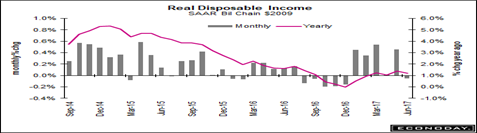
June’s Real Disposable Income was unchanged and May revised 1 tenth lower to a 0.3 percent gain, as I said in an earlier column. The real problem is weak wage growth, as most jobs being created are in low wage industries, like hospitality and even healthcare. Year-on-year, overall prices are up only 1.4 percent with the core little better at 1.5 percent.

image

Graph: Econoday

The 3 major employment sectors were Professional and Business Services, Healthcare, and Leisure and Hospitality as usual, all generally lower-paying job sectors.

Employment in food services and drinking places rose by 53,000 in July, said BLS. The industry has added 313,000 jobs over the year. Professional and business services added 49,000 jobs in July, in line with its average monthly job gain over the prior 12 months.

In July, health care employment increased by 39,000, with job gains occurring in ambulatory health care services (+30,000) and hospitals (+7,000). Health care has added 327,000 jobs over the past year.

What are those wages? In July, the BLS says, average hourly earnings for all employees on private nonfarm payrolls rose by 9 cents to $26.36. Over the year, average hourly earnings have risen by 65 cents, or 2.5 percent. In July, average hourly earnings of private-sector production and nonsupervisory employees increased by 6 cents to $22.10.

So the U.S. economy is in a bit of a bind, if it wants to grow faster. And that is a lack of population growth, one of two main drivers of GDP growth, when conservatives want to limit immigration?

The U.S. native population is barely growing, so where else are those workers coming from? And businesses are investing a bare minimum in capital expenditures, robots and other technologies that would increase productivity, the other driver of growth.

And then we have jumped off the Paris Accord bandwagon, when China is tripling its investments in alternative energy sources, such as wind and solar farms. That will also boost productivity and hence growth—for China and the rest of the world that isn’t ignoring climate change.

But conservative still have their heads stuck in coal mines, for some reason. Go figure. What century do they think we are living in?

Harlan Green © 2017

Follow Harlan Green on Twitter: https://twitter.com/HarlanGreen
Posted in Consumers, Economy, Macro Economics, Politics, Weekly Financial News | Tagged , , , | Leave a comment

Great Q2 GDP Growth, But Q3?

Popular Economics Weekly

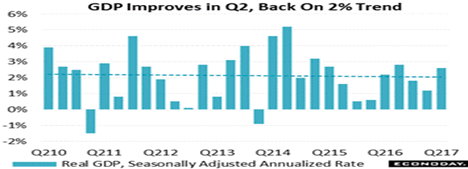
Second quarter GDP came in at a 2.6 percent annualized growth rate. This is one of the best showings of the last 2 years and keeps overall growth at 2 percent; because first quarter’s growth was downwardly revised to 1.2 percent. And Q3 growth isn’t looking good, as June personal income and expenditures (PCE) just took a huge plunge—not a good omen for Q3.

image

Graph: Econoday

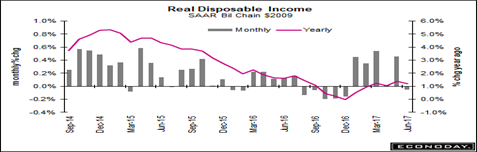
June PCE income was unchanged and May revised 1 tenth lower to a 0.3 percent gain. Consumer spending was up 0.1 percent gain. Price data are flat, unchanged in the month with the core rate (less food and energy) up 0.1 percent for a second weak month in a row. The real problem is weak wage growth, as most jobs being created are in low wage industries, like hospitality and even healthcare. Year-on-year, overall prices are up only 1.4 percent with the core little better at 1.5 percent.

image

Graph: Econoday

What is wrong with the U.S. economy that it can’t grow faster? Nothing, really, given almost no productivity growth, and an aging population. This is maximum speed without an increase in productivity, in other words, and that won’t happen unless some of the $4.6T in deferred infrastructure spending gets done.

Can you imagine what new highways, bridges, airports, energy infrastructure, city and state water treatment facilities would do to productivity growth? Labor productivity rose at an average annual rate of 3-1/4 percent from 1948 to 1973, says the Federal Reserve, whereas, the average growth rate of productivity was about 1.7 percent in the period 1974 to 2016.

“If labor productivity grows an average of 2 percent per year,” said Fed Vice-Chair Stanley Fischer in a recent speech, “average living standards for our children’s generation, will be twice what we experienced. If labor productivity grows an average of 1 percent per year, living standards will take two generations to double.”

“Governments can take sensible actions to promote more rapid productivity growth,” continued Fischer. “Broadly speaking, government policy works best when it can address a need that the private sector neglects, including investment in basic research, infrastructure, early childhood education, schooling, and public health.”

But construction spending also dropped in June—1.3 percent, mainly highways and streets in the government sector. Construction spending in manufacturing was also down. Doesn’t congress realize this is a sign that infrastructure expenditures are going down, rather than rising? This should be the priority, not attempting to repeal Obamacare, or cut taxes.

Our deficit problems would be solved if congress would focus on policies that really matter—like increasing spending on factors that enhance productivity, which would in turn increase GDP growth, which would in turn lower the budget deficit and obviate the need for draconian tax cuts.

“Reasonable people can disagree about the right way forward, but if we as a society are to succeed, we need to follow policies that will support and advance productivity growth. That is easier said than done. But it can be done,” says Fischer.

Economists such a Stanley Fischer know how this is done. In fact, we can only really survive as a viable democracy if we listen to the experts, rather than political ideologues.

Harlan Green © 2017

Follow Harlan Green on Twitter: https://twitter.com/HarlanGreen
Posted in Economy, Keynesian economics, Politics, Weekly Financial News | Tagged , , , , | Leave a comment

Why are Americans So Unhealthy?

Financial FAQs

Americans have just avoided a health care disaster in voting down the Senate’s ‘skinny’ Obamacare Repeal and Replace bill. Even though maintaining most of the taxes to pay for the Medicaid portion, it would have made insurance coverage prohibitively expensive for those older and sicker users with the removal of the private and employer mandate requirements that would cause younger and healthier people to leave the insurance markets.

This is really the latest precipice that’s been avoided. Americans already have the worst health outcomes in the developed world, precisely because America is the only developed country—in fact, of most of the rest of the undeveloped world as well—that doesn’t have universal coverage.

The result is one of the highest birth death rates, as well as heart, diabetes, and infectious disease rates—which are diseases usually associated with poorer, undeveloped countries and regions.

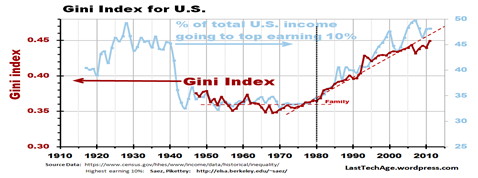
Why has this happened in the America? Because Americans have the worst income inequality in the developed world, according to the CIA World Factbook. And studies have shown that those countries with the greatest inequality also rank lowest in healthcare benefits.

image

Graph: Last Tech Age

The U.S. ranks 106th of the 149 countries in income inequality as ranked by the CIA’s World Factbook; with a Gini inequality index of developing countries like Peru and Cameroon. Whereas Finland and the Scandinavian countries are at the top of equality rankings, Germany and France are 12th and 20th, respectively, as I’ve highlighted in past columns. The higher the index in the graph, the greater the gap between wealthy and poorer citizens of a country’s population.

This is while congress has even been attempting to take away Medicaid benefits for the poor, elderly and infirmed? It doesn’t compute. Just 3 Senators—Lisa Murkowski, Susan Collins and John McCain—were courageous enough to stand up to the conservative lobbies

What if conservatives had succeeded in repealing Obamacare? That would only worsen healthcare outcomes.

“Republicans’ Obamacare repeal bill would leave 17 million more people uninsured next year, and 32 million more in 2026, the Congressional Budget Office said in an estimate Wednesday. It also said premiums would double by 2026. …By 2026, three quarters of the population would live in areas with no insurers participating in the non-group market, due to upward pressure on premiums and downward pressure on enrollment, the report found.”

On the other hand, a 2016 Commonwealth Club study lists Obamacare’s many benefits. “…evidence indicates that the ACA has likely acted as an economic stimulus, in part by freeing up private and public resources for investment in jobs and production capacity. Moreover, the law’s payment and other cost-related reforms appear to have contributed to the marked slowdown in health spending growth seen in recent years.”

Some of those benefits are:

· Health care spending growth per person—both public and private—has slowed for five years. 

· A number of ACA reforms, particularly related to Medicare, have likely contributed to the slowdown in health care spending growth by tightening provider payment rates and introducing incentives to reduce excess costs. 

· Faster-than-expected economic growth and slower-than-expected health care spending have led to multiple downward revisions of the federal deficit and projected deficits.

· These trends have also been a boon to state and local government budgets, as job growth has improved state tax revenues while cost growth in health care programs has slowed. At the same time, expanding insurance to millions of people who were previously uninsured has supported local health systems and enhanced families’ ability to pay for necessities, including health care.

· The accrued savings in health care spending relative to their projected growth prior to the ACA are substantial: Medicare alone is now projected to spend $1 trillion less between 2010 and 2020.

We can thank Senators Merkowski, Collins, and McCain that the so-called ‘freedom’ lobbies behind the Obamacare repeal effort have not succeeded in making more Americans ill. I don’t even want to imagine the increased death totals due to lack of care of the 32 million aged and infirm that could ultimately lose their coverage.

Now is the time, in Senator McCain’s words, for Republicans and Democrats to work together in “regular order” to craft a truly bipartisan healthcare bill that could actually improve the health of Americans.

Harlan Green © 2017

Follow Harlan Green on Twitter: https://twitter.com/HarlanGreen
Posted in Consumers, Economy, Uncategorized | Tagged , , , , , , | Leave a comment

The End of Easy Money?

Popular Economics Weekly

The Fed just completed its July FOMC meeting and said the sale of some of its $4.5 trillion in securities would begin this year. CNBC has predicted the first installment of $300B in sales could begin anytime. This is a mere drop in the bucket and shouldn’t affect interest rates immediately.

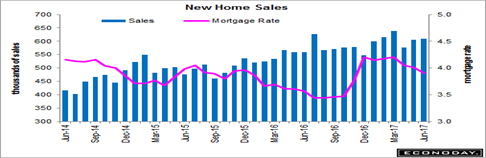
Why? There is simply too much easy money in circulation, which is why the 10-year Treasury yield is still in the 2.3 percent range, and 30-year conforming fixed mortgage rates are below 4 percent. Money is cheap, in other words, which hurts savers but helps borrowers, such as homebuyers.

This is indeed helping homeowners, as June new-home sales just jumped 0.8 percent and are 11 percent higher this year. Should the Fed begin to sell securities they bought via the various Quantitative Easing securities purchases, it will take some of that excess money out of the economy, but should not slow down home buying.

image

Graph: Econoday

This is because interest rates only go up if inflation rises, and the Fed’s preferred inflation gauge, the Personal Consumption Expenditures index, has tapered off to 1.4 percent growth over 12 months from a five-year high of 2.1 percent. That is not a good sign for future demand and hence growth, as I’ve been saying. But it’s good for borrowers and homebuyers.

“The month’s (new-home) sales report is consistent with our forecast, and we should see further gains throughout the year as the labor market continues to strengthen,” said NAHB Senior Economist Michael Neal. “While new home inventory rose slightly in June, it remains tight as builders face lot and labor shortages and increases in building material costs.”

The assessment of both current and future business conditions is also strong with more describing them as good. Buying plans for homes is also a positive, up a sharp 7 tenths to 6.7 percent with buying plans for autos also up, 1 tenth higher to 12.7 percent.

image

Graph: Econoday

So the expected rise in interest rates is just not happening. Inflation is really a gauge of present and future demand and the demand by consumers, even for so-called capital expenditures by businesses that would expand production, isn’t happening. Capex spending jumped slightly earlier this year, but has slowed and manufacturing activity is still in a positive but narrow range.

However, consumer confidence continues to soar. The Conference Board’s index is back to its highest level this year. The index rose nearly 4 points in July to 121.1. Confidence has risen about 20 points following the November election, hitting a 17-year peak of 124.9 in March. Is this due to the Trump election? We haven’t yet seen higher retail sales and other indicators of greater consumer spending that would boost GDP growth to 3 percent as Republicans have promised.

So what are consumers up to? They seem to want to save most of their earnings at present, which is a sign that consumers are not yet convinced higher economic growth is in the cards, in spite of the availability of so much easy money.

Harlan Green © 2017

Follow Harlan Green on Twitter: https://twitter.com/HarlanGreen
Posted in Consumers, Economy, Housing, housing market, Weekly Financial News | Tagged , , , , , , | Leave a comment

Home Sales Disappoint

The Mortgage Corner

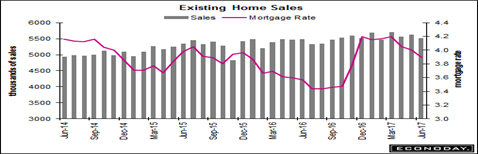
Existing-home sales were at a 5.52 million seasonally adjusted annual rate in June, the National Association of Realtors said Monday. That was 0.7 percent above the year-ago rate, but 1.8 percent lower than in May and marked the second-lowest monthly total of 2017.

image

Graph: Econoday

Why? There’s a severe housing shortage with inventories down to a 4.3-month supply at the current sales rate. It is so bad that Zillow Chief Economist Svenja Gudell in a Marketwatch interview said, “There are about as many homes for sale now as there were in 1994 (1.96m), except there are about 63 million more people in this country now than there were then.”

The supply imbalance continues to push prices higher. The median sales price was $263,800 nationally, a 6.5 percent increase compared with the year-earlier period. The median price in California is now $500,000. That sets a fresh record and marks the 64th consecutive month of yearly price gains, with housing prices growing at roughly double the rate of wage gains.

It’s hard to understand why builders aren’t answering the call with demand so high and interest rates still at record lows. Part of the problem is there are so few entry-level homes being built.

“Closings were down in most of the country last month because interested buyers are being tripped up by supply that remains stuck at a meager level and price growth that’s straining their budget,” said NAR economist Lawrence Yun. “The demand for buying a home is as strong as it has been since before the Great Recession. Listings in the affordable price range continue to be scooped up rapidly, but the severe housing shortages inflicting many markets are keeping a large segment of would-be buyers on the sidelines.”

First-time buyers were 32 percent of sales in June, which is down from 33 percent both in May and a year ago. The longer-term average is 40 percent for first-timers as a percentage of all buyers, which are mainly younger buyers.

image

Graph: Apartment List

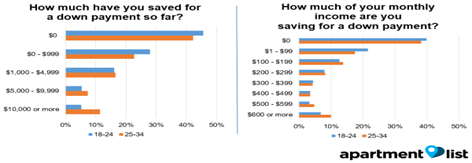
CNBC reports new data from Apartment List that shows although 80 percent of millennials would like to purchase real estate, very few are in a good position to buy, largely because they have nothing saved. According to the report, “68 percent of millennials said they have saved less than $1,000 for a down payment. Almost half, or 44 percent, of millennials said they have not saved anything for a down payment.”

That is probably why mortgage lenders are now offering more exotic products, such as a 1 percent down payment for the conforming 30-year fixed rate with the lender chipping in another 2 percent, so that it satisfies the minimum 3 percent minimum down payment requirement for conforming loans.

Lenders are also offering high end buyers a 40-year fixed rate program for super jumbo loan amounts with the first 10 years at interest only payments. Payments then become standard 30 year principal and interest payments for the rest of the 30-year term.

Meanwhile the standard 30-year conforming fixed rate remains at 3.50 percent for 1 origination point in California, as it has been for months. There are still many buyers out there, in other words, but the most important population segment is the millennial generation who marry later and have those student debt problems.

Harlan Green © 2017

Follow Harlan Green on Twitter: https://twitter.com/HarlanGreen
Posted in Consumers, Housing, housing market, Weekly Financial News | Tagged , , , , | Leave a comment

Full Employment Is Here, But No Inflation (Revised)

Financial FAQs

The Bureau of Labor’s JOLTS Job Openings and Labor Turnover Survey out Tuesday showed a huge boost in hiring and shrinkage of available jobs. What to make of it with almost nonexistent inflation, and the Fed’s Janet Yellen still making noises about raising interest rates?

image

Graph: Marketwatch

Job openings fell back 5.0 percent to 5.666 million in May from 6 million, and hiring shot up 8.3 percent at 5.472 million from 5 million in April. So the number of net new job openings shrank from 1 million to a mere 194,000, while more than 400,000 new jobs were created! This is big news, and sets a record for this series while the number of job openings are the second lowest of the year.

Meanwhile, Janet Yellen can’t seem to make up her mind on the direction of economic growth in her latest congressional testimony. So she won’t commit to further rate hikes at the moment, which without growing inflation would slow growth, rather than be a sign of inflation (and growth) ahead.

“As I’ve said on many occasions, the new normal with respect to what level of interest rates is neutral appears to be rather low, so we have raised the federal-funds rate target. I believe policy remains accommodative.”

In what is one of the very weakest 4-month stretch in 60 years of records, says the Census Bureau, core consumer prices could manage only a 0.1 percent increase in June. This is the third straight 0.1 percent showing for the core (ex food & energy) that was preceded by the very rare 0.1 percent decline in March. Total prices were unchanged in the month with food neutral and energy down 1.6 percent.

image

Graph: Econoday

The JOLTS report looks like employers’ job hirings are finally catching up with their job openings. Other movement in this report is a 1 tenth rise in the quits rate to 2.2 percent which hints perhaps at worker confidence and willingness to switch jobs which may be a positive for wage growth.

Such a strong jobs report should mean wages are about to rise, in other words. At least the Fed believes so, but it ain’t yet happening, no matter what Dr. Yellen says. Wages have been at 2.5 percent over the past 2 years; just enough to pay current bills, but not to boost retail sales, a major component of consumer spending, hence GDP growth.

Retail sales fell an unexpected 0.2 percent in June. This follows a revised 0.1 percent decline in May and a revised 0.3 percent gain for April which proved to be the quarter’s only respectable showing.

Econoday says it “…shows wide weakness with vehicle sales coming in with a marginal 0.1 percent increase, the same for furniture and also electronics & appliances. Declines include food & beverage stores, down a sharp 0.4 percent, and department stores down 0.7 percent following the prior month’s 0.8 percent plunge.”

So where is the inflation? Economic growth is still weak because demand is weak, and maybe declining. This is worrisome.

Today’s CPI retail inflation report should convince Dr. Yellen that no further Fed rate hikes are warranted. Annual inflation has increased just 1.6 percent; 1.7 percent without volatile food and energy prices. And we have June’s unemployment report with 222,000 new payroll jobs, another sign of full employment. (It is seasonally adjusted, which is why it differs from the JOLTS numbers.)

Then there is the fact that interest rates aren’t rising.  The 10-year Treasury yield is still at 2.26 percent, which would normally signal an incoming recession.  Let us hope not, since there are still jobs available and we have to first see wages rising!

Harlan Green © 2017

Follow Harlan Green on Twitter: https://twitter.com/HarlanGreen

Posted in Consumers, Economy, Politics, Weekly Financial News | Tagged , , , , , , | Leave a comment

Housing Starts Rebound, For How Long?

The Mortgage Corner

The Conference Board’s Index of Leading Indicators that predicts future growth says it is being boosted by a rebound in housing starts, which means more badly needed new homes being built. Its June report posted a 0.6 percent gain. Permits had been soft through most of the spring before gaining sharply in this week’s housing starts report.

But there’s concern whether this might last, though I predict full employment and the prospect of low interest rates for the rest of this year could prolong this trend.

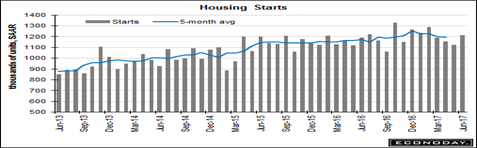
Starts for all homes jumped 8.3 percent in June to a 1.215 million annualized rate with permits up 7.4 percent to a 1.254 million rate. As weak as the details were in the prior report, is how strong they are in the latest. Single-family permits rose a huge 4.1 percent to an 811,000 rate with multi-family permits up 13.9 percent to 443,000. Permits are strongest in the Midwest followed by the West and South.

image

Graph: Econoday

Actual starts for single-family homes rose 6.3 percent in June’s report to 849,000 with multi-family up 13.3 percent to 366,000. The Northeast is in front followed by the Midwest. Starts in the West are up slightly and are down noticeably in the South, probably due to the errant weather, including floods and a few tornadoes.

The LEI tracks 12 indicators of growth, including interest rates spreads and hours worked. The fact that housing permits provided the biggest boost to the LEI means that housing is probably a leading indicator of future growth as it has been in past recoveries.

So why has it taken so long for housing construction and sales to catch fire? The busted housing bubble left millions of vacant homes that first had to be reabsorbed into the housing market.

Then all those homeowners that lost their homes had to reestablish their credit bonafides. This is while Fannie Mae and Freddie Mac haven’t sufficiently lowered their credit and loan qualifying requirements that would add some 1 million prospective homebuyers to the list of eligibles, according to the Urban Institute.

Then there is the millennial generation saddled with too much student debt that the current administration doesn’t want to forgive or amend. The list goes on and on, in other words, for what needs to be done to bring back more affordable housing.

The NAHB, or National Association of Home Builders also puts out a builder sentiment index that attempts to predict future activity, but which may lag housing starts data. The report cites the effects of high lumber costs on home builders in showing construction, for instance, but shows slower activity evenly divided among the 3 components in its index.

Higher future sales still lead for 73 percent of respondents with higher present sales at 70 percent of those polled. But only 48 percent report higher traffic, which is below breakeven 50 for the 2nd month in a row. Regionally, the West remains the strongest for homebuilders followed by the Midwest and South and the Northeast far behind. So is optimism leading reality, if fewer buyers are lookng?

These are still terrific numbers, however, and it looks like lower interest rates are here for the rest of this year, with the conforming 30-year fixed rate holding at 3.50 percent for one origination point in California.

Why are rates still at such record lows with the Fed having already raised their overnight rate 3 times to 1.25 percent? Consumers aren’t borrowing more, which would increase loan rates.

image

Graph: Econoday

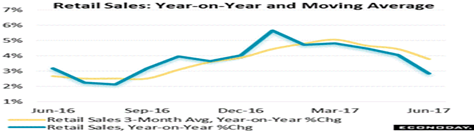
For instance, retail sales are still stuck below what is considered to be a robust demand for more goods and services. Annual sales are under 3 percent for the first time since August last year with the 3-month average below 4 percent. And 6 percent annual sales increases have been the norm during past recoveries.

This really means a certain middle and upper segment of income earners are doing well, but not the rest of US. The boosting of the minimum wage in the more prosperous cities and states is a start, but that is happening in only a handful of those states, as I’ve said.

Much more needs to be done, in other words, to help the still record income inequality that haunts this laggard recovery from the Greatest Recession since the Great Depression.

Harlan Green © 2017

Follow Harlan Green on Twitter: https://twitter.com/HarlanGreen
Posted in Consumers, Economy, Housing, housing market, Weekly Financial News | Tagged , , , , , | Leave a comment

Full Employment Here, But No Inflation?

Financial FAQs

The Bureau of Labor Statistic’s JOLTS Job Openings and Labor Turnover Survey out Tuesday showed a huge boost in hiring and shrinkage of available jobs. What to make of it with almost nonexistent inflation, and the Fed’s Janet Yellen still making noises about raising interest rates?

image

Graph: Steve Goldstein

Job openings fell back 5.0 percent to 5.666 million in May from 6 million, and hiring shot up 8.3 percent at 5.472 million from 5 million in April. So the number of net new job openings shrank from 1 million to a mere 194,000, while more than 400,000 new jobs were created! This is big news, and sets a record for this series while the number of job openings are the second lowest of the year.

Meanwhile, Janet Yellen can’t seem to make up her mind on the direction of economic growth in her latest congressional testimony. So she won’t commit to further rate hikes at the moment, which without growing inflation would slow growth, rather than be a sign of inflation (and growth) ahead.

“As I’ve said on many occasions, the new normal with respect to what level of interest rates is neutral appears to be rather low, so we have raised the federal-funds rate target. I believe policy remains accommodative.”

In what is one of the very weakest 4-month stretch in 60 years of records, says the Census Bureau, core consumer prices could manage only a 0.1 percent increase in June. This is the third straight 0.1 percent showing for the core (ex food & energy) that was preceded by the very rare 0.1 percent decline in March. Total prices were unchanged in the month with food neutral and energy down 1.6 percent.

image

Graph: Econoday

The JOLTS report looks like employers’ job openings are finally catching up with their hiring. Other movement in this report is a 1 tenth rise in the quits rate to 2.2 percent which hints perhaps at worker confidence and willingness to switch jobs which may be a positive for wage.

Such a strong jobs report should mean wages are about to rise. At least the Fed believes so, but it ain’t yet happening, no matter what Dr. Yellen says. Wages have been at 2.5 percent over the past 2 years; just enough to pay current bills, but not to boost retail sales, a major component consumer spending, hence GDP growth.

Retail sales fell an unexpected 0.2 percent in June. This follows a revised 0.1 percent decline in May and a revised 0.3 percent gain for April which proved to be the quarter’s only respectable showing.

Econoday says it “…shows wide weakness with vehicle sales coming in with a marginal 0.1 percent increase, the same for furniture and also electronics & appliances. Declines include food & beverage stores, down a sharp 0.4 percent, and department stores down 0.7 percent following the prior month’s 0.8 percent plunge.”

So where is the inflation? Economic growth is still weak because demand is weak and maybe declining. This is worrisome.

Today’s CPI retail inflation report should convince Dr. Yellen that no further Fed rate hikes are warranted. Annual inflation has increased just 1.6 percent; 1.7 percent without volatile food and energy prices. And we have June’s unemployment report with 222,000 new payroll jobs, another sign of full employment. (It is seasonally adjusted, which is why it differs from the JOLTS numbers.)

Harlan Green © 2017

Follow Harlan Green on Twitter: https://twitter.com/HarlanGreen
Posted in Consumers, Economy, Weekly Financial News | Tagged , , , , , , | Leave a comment

Minimum Wage Raises Should Boost Employment, Spending

Financial FAQs

Minimum wages are about to rise in several cities, and eventually states. San Francisco and Los Angeles minimums rose last weekend to $14 and $12 per hour, respectively, and ultimately to $15 per hour by 2021. But Seattle, Washington, Washington D.C., Chicago, Maryland, and New York will be raising their minimum wages, as well.

This should finally boost incomes, and maybe consumption for the rest of 2017. Central Banks are beginning to raise their rates, as well, which means they see stronger growth ahead.

But this all depends on the consumer, as businesses won’t spend and boost hiring until they see consumers spending more. Friday’s unemployment report told us we see growing demand ahead. The various QE programs and extremely low inflation have kept long term rates below 3 percent for several years because consumer incomes have been trending down lately, as I’ve said.


image

Graph: Econoday

For instance, personal income has been struggling, posting only a 3.5 percent year-on-year rate the last two months with the trend line pointing to just under 3 percent, reports Econoday. And that has kept spending in a narrow 4-5 percent range, as well.

Last week’s ISM service sector activity report could mean more hiring ahead, since the service sector employs roughly two-thirds of American workers. Its non-manufacturing survey continues to report extending strength with the index up 5 tenths in June to 57.4. New orders, at 60.5, remain unusually strong with backlog orders, at 52.0, also rising in the month. New orders for export, at 55.0, are also up solidly though to a lesser degree than domestic orders.

“The non-manufacturing sector continued to reflect strength for the month of June. The majority of respondent’s comments are positive about business conditions and the overall economy,” said Anthony Nieves, Chair of the Institute for Supply Management Non-Manufacturing Business Survey Committee.

But this is anecdotal evidence only, and actual government statistics don’t reveal increased activity yet. Factory orders show manufacturing activity still rising at 5 percent, but autos and aircraft orders are down now, after surging earlier this year.

image

Manufacturing was once known to have high paying jobs. That’s old history with pay, now at about $26.50, only 25 cents above the average. And payroll growth has also been slow with this trend also fighting to stay above zero.

“Backlogs are the bottom line and, despite all the confidence in all the private surveys, they are still under water, says Econoday. “Until unfilled orders pile up, gains for factory payrolls and wage will be limited. Despite a big jump in ISM’s employment index, actual factory payrolls rose only 1,000 in Jun

So while jobs continue to be filled, wages aren’t rising in tandem, and that is another sign that there are still 6 million workers looking for jobs. Until that happens we cannot say we have reached full employment.

Harlan Green © 2017

Follow Harlan Green on Twitter: https://twitter.com/HarlanGreen

Posted in Consumers, Economy, Politics, Weekly Financial News | Tagged , , , , , | Leave a comment