Aren’t Tax Cuts Wonderful?

Popular Economics Weekly

Those were President Trump’s words on the $3.2 trillion in tax cuts enacted by the Republican majority congress before Christmas. “These are the biggest tax cuts in history, even bigger than President Reagan’s.” He’s right that they will be wonderful for corporations, and the highest income earners, but not for most of U.S.

So President Trump will have to show that these cuts continue to create jobs.  He has promised 10 million jobs in the first four years. The numbers are looking good in his first year, the ninth year of this economic recovery from the Great Recession. But one ingredient is lacking; government job creation. Federal government job rolls shrank during Trump’s first 11 months, and history shows that governments have to hire enough to keep up the job numbers, and provide essential services that aid economic growth.

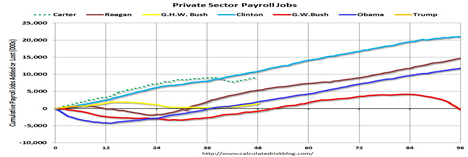
In addition, tax cuts have never created many jobs. Though accounting for job creation under the various presidential administrations is tricky since business cycles don’t match presidential terms, they provide a superficial look at which tax policies have worked best.
image

Graph: Calculated Risk

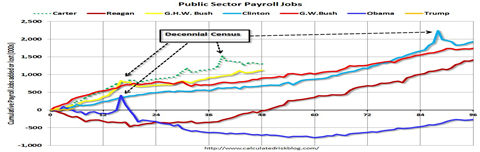
Taxes were raised during President Clinton’s eight years with 20, 966,000 private payroll jobs created. President Reagan comes in second at 14,717,000, but had to raise taxes 11 times to reduce the ballooning deficit caused by the tax cuts. The difference is that Clinton had no recessions during his terms, while Reagan had two during his early years. But taxes were raised in both cases to create more jobs, in part to fund enough government jobs that are needed to create a fully employed economy.

Under Clinton, 1,934,000 public sector jobs (i.e., federal and state) were created, and 1,414,000 under President Reagan, whereas federal jobs declined 14,000 in Trump’s first 11 months, according to the Washington Post.
image

Graph: Calculated Risk

President Obama actually lost jobs during his first months as president due to the Great Recession, but ended up with 1,937,000 jobs in his first term and 11,756,000 jobs over eight years. And government payrolls actually declined 268,000 during Obama’s eight years due to a number of factors; which was when Republicans took over control of the House in 2010 and cut federal spending when they cared about deficits.

Alas, that is no longer so, as the new tax bill is actually programmed to add $1.5 trillion to the national debt, and President Trump wants to reduce government budgets by 30 percent in 2018.

That will not create the necessary jobs to keep job rolls full and deficits down. Government spending is too necessary to fund all the programs that the private cannot or will not, including health care, public infrastructure, education, and R&D that fund future prosperity.

How did we build our highway system, go to the moon, and create the Internet? With government spending. But that was all done before 1980 when government became the problem for Republicans and tax cuts the answer.

Now it seems that budget deficits are no longer a problem for Republicans, and President Trump is counting on those 10 million new jobs to justify the tax cuts. He’s not off to a good start, in part because this is the ninth year of this recovery cycle, and the post- World War II record is ten years that included President Clinton’s term.

Harlan Green © 2018

Follow Harlan Green on Twitter: https://twitter.com/HarlanGreen

Posted in Economy, Keynesian economics, Politics, Weekly Financial News | Tagged , , , , , | Leave a comment

What Happens in 2018?

Popular Economics Weekly

The New Year will make some people very wealthy—mainly stockholders, corporate execs, and real estate moguls. And as minimum wages begin to rise this year in many cities and states (but not all), those at the lower income end will also get a boost. But the middle class? They will be hit hardest by the limit to property tax and mortgage deductions in the new tax bill. And don’t forget the spending cuts to the social programs that will lower incomes of those dependent on Medicare and Medicaid.

However, this is a column about the prospects for higher paying jobs and economic growth. And it looks like upcoming statistics will show the ninth year of solid growth. But that is only if Congress finally enacts an infrastructure bill that would not only boost higher paying jobs, but productivity as well. The hurricane devastations and winter ‘bomb’ cyclones make that an obvious priority.

Just 148,000 new nonfarm payroll jobs were added to payrolls in December, according to the U.S. Bureau Labor Statistics, down from the prior two months’ 232,000 average. But economists believe it was partly due to the extreme winter weather that has essentially snowbound the northern half of the U.S.

Everyone needs to see The Day After Tomorrow, a harrowing movie about extreme climate change that brings in a new Ice Age, to understand what can happen if such extreme weather conditions continue.

All else was strong with the unemployment rate holding at 4.1 percent. Job gains were led by the health care, construction and manufacturing sectors. Other industries had smaller gains. The only significant weakness was in the hard-hit retail sector, which shed more than 20,000 jobs.

image

Graph: Marketwatch

The number of persons employed part time for economic reasons (sometimes referred to as involuntary part-time workers) was essentially unchanged at 4.9 million in December but was down by 639,000 over the year. These individuals, who would have preferred full-time employment, were working part time because their hours had been cut back or because they were unable to find a full-time job.

So this economy is putting people back to work, and could equal the Clinton recovery from 1991 to 2001 before GW Bush cut taxes and swelled the federal deficit once more; that had actually been in surplus for the last 4 years of the Clinton administration.

The lesson we learned then was Clinton had to raise taxes and cut back military spending, the largest portion of the federal budget. But Republicans once again are adding to the deficit and overall debt with their tax cuts.

So the real silliness in 2018 will be one party believing that cutting taxes and social programs will keep the federal debt from growing even larger. Not possible, because over the long term the monstrous federal debt will take even more money out of the economy and growth to pay the interest required to service said debt that could grow to $25 trillion in ten years, according to some projections.

And the Fed will keep raising interest rates at the same time to prepare us for the next recession.

Harlan Green © 2018

Follow Harlan Green on Twitter: https://twitter.com/HarlanGreen
Posted in Consumers, Economy, Keynesian economics, Politics, Weekly Financial News | Tagged , , , , , | Leave a comment

2017—A Nightmare Year

Popular Economics Weekly

“For what does it profit a man to gain the whole world and forfeit his soul?” Jesus was to have said to his disciples. This should be the proverb that describes 2017, a year of lost souls.

What does it say about a country that elects a President who shows no sign of having a soul, but only wants profits for himself and his cronies?

Most Americans in 2017 have seen rock-bottom American values such as equality, justice, and tolerance assaulted to bring back a gilded age that profits a few. Instead of draining the DC swamp, President Trump has filled it with a record number of lobbyists; either writing the bills Republicans are pushing through congress, or installing lobbyists in the very government agencies they are tasked to regulate.

The 2017 nightmare began on the election of Donald Trump that will forever be tainted by Russia’s well-documented attempts to tilt the election to Trump and the Republican Party.

George Will, the conservative pundit, gave the best description of Trump’s inabilities in a Washington Post Op-ed: “It is urgent for Americans to think and speak clearly about President Trump’s inability to do either. This seems to be not a mere disinclination but a disability. It is not merely the result of intellectual sloth but of an untrained mind bereft of information and married to stratospheric self-confidence.”

Practicing and academic psychotherapists have said more; that Trump is mentally ill, or has an untreatable Narcissistic Personality Disorder, but either way, he lives in a fantastical world of his own making the almost completely ignores the reality that most Americans live.

The nightmare grew when we learned Russia may have been behind many of the dirty tricks, and anti-Hillary chants of “Lock Her Up” made by Trump campaign advisers such as General Flynn. We now know the FBI began its counter-intelligence operation of the Trump campaign in the summer of 2016, when it learned that the Russians had hacked both Republican and Democratic Party emails.

But Russia only weaponized the Democrats’ hacked emails via WikiLeaks, Facebook, and Twitter, not those of the Republicans. Therefore the suspicion has to be that Russia could blackmail one or more Trump campaign operatives into spying for them because Russia didn’t publicize the Republicans’ emails—maybe even President Trump and his family? That is precisely what the FBI’s counter-intelligence investigation wants to determine.

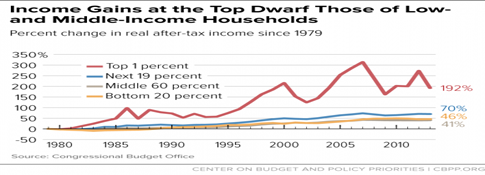
But the greatest nightmare of 2017 may be the record income inequity that was exemplified in the just-passed tax cuts that are to be paid for with up to $3 trillion in added federal debt plus spending cuts to Medicare and Medicaid over the next ten years, which impoverish the poorest among US.

Professors Thomas Piketty and Emmanuel Saez were the first to examine 100 years of income tax returns that highlighted the wide swings in income equality. They found that the periods of greatest inequality were just before a major recession, such the as the Great Recession, and the Great Depression itself.

Both were the result of record income inequality. The greatest prosperity was post-WWII, when the modern American middle class was formed due to rapid economic growth and unionization of the workforce.

image

Graph: CPBB

When will the 2017 nightmare end? Maybe in 2018, if a majority of Americans realize the fantasy world the current administration and congress has created is not theirs; but Americans see a world in which life, liberty and the pursuit of happiness is available to all.

Harlan Green © 2017

Follow Harlan Green on Twitter: https://twitter.com/HarlanGreen
Posted in Economy, Keynesian economics, Politics, Weekly Financial News | Tagged , , , , , | Leave a comment

Whither Go 2018 Interest Rates?

Financial FAQs

The 10-year benchmark Treasury yield dropped 5.12 points yesterday, the biggest drop in 5 months, according to Marketwatch. It is hovering just above a 2.4 percent yield—which is why one can still obtain a 30-year fixed rate conforming mortgage rate for 3.50 percent, and why the housing market is booming.

But this is ridiculously low, and signals something is very wrong with our economy. The 10-year T yield during normal times of prosperity is usually 1 percent higher, in the 3 to 4 percent range, as are mortgage rates. Why have interest rates and inflation remained so low for so long—since 2009 and the end of the Great Recession?

So little inflation over such a long period shows the sad state of financial affairs for most Americans. We have a record income inequality—the worst in the developed world—that has meant consumers that power most of the demand for goods and services have become financially strapped.

And consumer spending is the main driver of economic growth. It is why GDP growth has averaged just 2.1 percent since the Great Recession that threw so many people out of work.

We rank just above Jamaica, Peru and other small developing countries in income inequality. And that is the major reason for the political polarization and dysfunction of government that can’t provide basic social services to most Americans; which would mitigate some of the income inequality.

The new Republican tax bill takes another $1.5 trillion away from Medicare and Medicaid benefits over the next ten years, according to most analyses, that will further exacerbate their poverty.

image

Harold Myerson of The American Prospect recently said, “The United States now has the highest percentage of low-wage workers – that is workers who make less than two-thirds of the median wage- of any developed nation. Fully 25 percent of all American workers make no more than $17, 576 a year.”

Why does all this matter? Because it means America’s middle class has been gutted, and it is our middle class that has provided the political stability between the two parties, and enabled compromise.

Because our middle class has shrunk, our politics have drifted to the right and another gilded age, where the wealthiest control most of the wealth and power, as happened at the beginning of the 20th century in the age of President William McKinley.

The current example of Republicans’ tax reform is the best example of our rightward drift. Democrats weren’t allowed any amendments or hearings, and consequently not a single Democrat in both legislative houses voted for the bill.

This drift towards Oligarchy that last happened more than 100 years ago is also the reason for our growing isolation from the rest of the world, and the loss of democratic values Americans are currently experiencing—such as fairness and equal justice for all races and economic classes.

So, as much as everyone hates inflation and loves low interest rates, these rates have to rise to levels that prevailed before the Great Recession to enable greater prosperity for all, not just the top one percent of income earners. And that won’t happen when one political party can enact a ‘tax reform’ bill that shifts more Americans’ wealth away from the majority of Americans.

Harlan Green © 2017

Follow Harlan Green on Twitter: https://twitter.com/HarlanGreen

Posted in Economy, housing market, Keynesian economics, Politics, Weekly Financial News | Tagged , , , , | Leave a comment

More Repub Lawlessness—Greatest Theft in History

Financial FAQs

The Republican’s tax bill has passed, and it is the greatest theft of taxpayer monies in history; even greater than Presidents’ Reagan and Bush I and II tax cuts that began the immense transfer of wealth to the wealthiest in 1980, starving the government of much needed revenues that would keep the federal deficits under control.

It was written by the very lobbyists Republicans and the Trump administration have cultivated since his election. The stench of the DC swamp that Trump promised to drain has become overwhelming.

More than 130 lobbyists have been hired to work in the administration, and 36 of them have blatant conflicts of interest, working on the same issues they were lobbying on, in violation of Trump’s ethics rules, according to Marketwatch economist Jeff Nutting.

image

Graph: @clairecmc

“This is so bad. We have just gotten list of amendments to be included in bill NOT from our R colleagues, but from lobbyists downtown,” said Missouri Dem Senator Claire McCaskill. “None of us have seen this list, but lobbyists have it. Need I say more? Disgusting. And we probably will not even be given time to read them.”

The bill will cut Medicare and Medicaid benefits by $1.5 trillion, and could add up to $1.5 trillion to the deficit in 10 years according to the CBO. That’s a $3 trillion outright theft from U.S. taxpayers that makes it the biggest heist in history.  It is why the top 1 percent of earners have garnered almost 100 percent of national income created since the end of the Great Recession. 

As I noted in an earlier column, Harold Myerson said in The American Prospect, “The United States now has the highest percentage of low-wage workers – that is workers who make less than two-thirds of the median wage- of any developed nation. Fully 25 percent of all American workers make no more than $17, 576 a year.”

We know what has happened when Republicans tried this taxpayer heist before. President Reagan and congress has to raise taxes 11 times to make up the deficits created by the first ‘trickle-down’ tax cuts in 1981. Two consecutive recessions followed as Fed Chairman Paul Volcker raised interest rates to record levels at the same time.

Then GW Bush did the same in 2001-03, when he cut taxes again while paying for the wars on terror, resulting in the largest federal deficit in history at the time, and the Great Recession.

This will not generate enough tax revenue to pay for the additional debt, as I noted in an earlier column, so foreign governments and individuals will become more reluctant to invest in U.S. debt as the deficit continues to grow and interest rates rise, while crowding out other, important investments.

It can happen again. It is suicidal economics. The U.S. won’t declare bankruptcy. But it will saddle future generations with an impossible debt load, and prevent much needed public and private investment that would increase productivity and boost growth.

Harlan Green © 2017

Follow Harlan Green on Twitter: https://twitter.com/HarlanGreen
Posted in Consumers, Economy, Keynesian economics, Politics, Weekly Financial News | Tagged , , , , , , , | Leave a comment

Housing Market Is Booming!

The Mortgage Corner

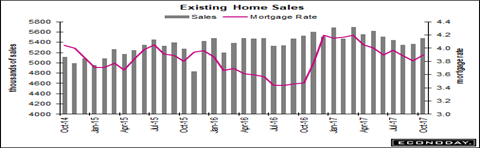
Both new and existing-home sales are highest since the end of the Great Recession, thanks to interest rates that are still at historical lows, and in spite of the Fed’s latest 0.25 percent rate hike. It looks like there are still plenty of homebuyers out there—actually, more buyers than homes for sale.

Sales of previously-owned homes surged 5.6 percent to an annual 5.81 million pace in November, the third month of increases and the strongest since December 2006, reports the NAR. Sales were 3.8 percent higher compared to a year ago in November.

This surpassed all predictions, and shows sales are far outdistancing supply. Unsold inventory would take 3.4 months to sell at the current pace, well below the 5-6 months’ worth of supply that normally signals a balanced market.

Lawrence Yun, NAR chief economist, says home sales in most of the country expanded at a tremendous clip in November. “Faster economic growth in recent quarters, the booming stock market and continuous job gains are fueling substantial demand for buying a home as 2017 comes to an end,” he said. “As evidenced by a subdued level of first-time buyers and increased share of cash buyers, move-up buyers with considerable down payments and those with cash made up a bulk of the sales activity last month. The odds of closing on a home are much better at the upper end of the market, where inventory conditions continue to be markedly better.”

image

Graph: Econoday

This is while housing starts and permits matched their unusual October strength with stronger-than-expected results for November. Starts rose 3.3 percent to a 1.297 million annualized rate and though permits fell 1.4 percent to 1.298 million, they show a 1.4 percent gain for the key single-family category to a 862,000 rate. And starts for single-family homes, up 5.3 percent to 930,000, are the highest of the expansion, since 2007.

Total completions fell 6.1 percent to a 1.116 million rate which is bad news for supply where thin conditions have held back sales. But homes under construction rose, up 1.0 percent to 1.110 million. Regional data show start strength in the West and South where permits were also strong in possible evidence of a hurricane reversal.

image

Graph: Econoday

“A welcoming trend is developing in the housing sector as builders are able to bring more supply to the market on a consistent basis,” said the NAR chief economist Lawrence Yun. “The latest monthly figure of near 1.3 million annualized housing starts is solid, and the growth is mostly coming both in the West and for single-family homes. 

“(But) There is still more room for improvement, as the latest figure is still not yet at the long-term 50-year average of produce 1.5 million units per year. If this rising trend continues, the worst of the supply shortage could soon end, which would help slow price appreciation in 2018. That would be a huge, welcoming relief for renters seeking to become homeowners.” 

Why are interest rates still at historical lows, in spite of Fed attempts to tighten credit with their four rate hikes, and more predicted to come? Money is still extremely plentiful and cheap, to put it bluntly. Major central banks are only now beginning to sell the $trillions they have amassed during the various Quantitative Easing programs that would reduce the money supply. 

This will continue to boost the housing market, needless to say. The only problem will be affordability for first-time homebuyers. The National Association of Realtors reports they constituted just 29 percent of all buyers in November, down from recent months and well below the long-term average of about 40 percent.

More buyers paid in cash in November, a trend that NAR said “continues to add a layer of frustration to the supply and affordability headwinds aspiring first-time buyers are experiencing.”

Harlan Green © 2017

Follow Harlan Green on Twitter: https://twitter.com/HarlanGreen

Posted in Consumers, Housing, housing market, Weekly Financial News | Tagged , , , | Leave a comment

Republican’s Tax Reform = U.S. Bankruptcy?

Popular Economics Weekly

We know most of the sordid details, by now. The Repubs’ about-to-be-approved tax bill will drive the U.S. into a defacto bankruptcy. It contains very little for the middle and lower income tax brackets that do the most to boost economic growth with their spending, and lots for the 1 percent that spend the least, including doubling the inheritance tax exemption and lowering both personal and corporate taxes.

This will not generate enough tax revenue to pay for the additional debt, so foreign governments and individuals will become more reluctant to invest in U.S. debt, as the deficit continues to grow and interest rates rise, crowding out other, important investments.

It also cuts Medicare and Medicaid benefits by approximately $1.5 trillion to pay for this huge tax cut. But that isn’t really paying for it, since this takes income away from those supported by our social programs.

How does that make sense, when financial markets are already flooded with cash, and all kinds of bubbles are popping up? Bond valuations are at all-time highs (meaning interest rates are still at historical lows), corporations are already making record profits, and stocks’ price-to earning levels resemble those of the 1929 market crash that led to the Great Depression.

Everything is already overvalued, in other words, yet the Republican congress wants to give even more money to the wealthiest, who plan to use it to boost their paychecks, and that of their stockholders.

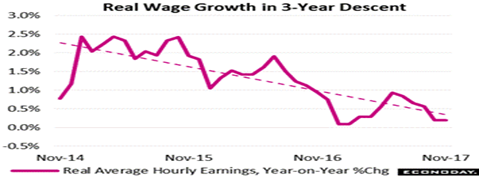
There will be little money left to boost wages and salaries, according to CEOs that have been surveyed. And why should they boost their workers’ incomes? Most new jobs are low paying, warehouse jobs for the likes of Amazon.


image

Graph: Econoday

It fantastical thinking to believe otherwise. A lack of skilled workers is very likely a key factor why high levels of employment have not led to meaningful wage improvement, says Econoday. Inflation is not rising because real average hourly earnings are barely rising, which is why discounting is still prevalent.

So congress is really reducing tax revenues that are needed to pay for all that debt. This is what GW Bush tried to do in 2001-2 with his tax cuts, which led to the record budget deficit, bursting of the original housing bubble, and Great Recession.

And it can happen again. It is suicidal economics, in that the U.S. won’t declare bankruptcy, since it can print all the money in our own currency to pay for the inflated debt levels. But it will saddle future generations with an impossible debt load, and prevent much needed public and private investment that would increase productivity and boost growth.

Harlan Green © 2017

Follow Harlan Green on Twitter: https://twitter.com/HarlanGreen

Posted in Consumers, Economy, Keynesian economics, Uncategorized, Weekly Financial News | Tagged , , , | Leave a comment

Treasury Yield Curve Too Flat, As Fed’s Raise Interest Rate

Popular Economics Weekly

The Federal Reserve FOMC meeting ended with the predicted 0.25 percent rate hike; but it’s happening at the wrong time.  This is the rate that controls credit card interest and the Prime Lending Rate banks use on short term loans, which will now become more expensive, slowing consumer spending, and hence economic growth, for starters. 

Few follow the trajectory of the so-called Treasury yield curve which graphs the difference between short and long-term interest rates. The curve is flattening at present—not a good sign for future growth. Instead, it’s historically a sign of slowing growth. 

image

Graph: FRED

DoubleLine Capital CEO Jeff Gundlach said this morning on CNBC the flattening yield curve is becoming worrisome, even with all signs pointing to no recession on the horizon. It will hurt junk bonds, for starters, as well as investors that are highly leveraged.

Why? The Fed is tightening at the same time as the Repubs’ proposed tax bill will add at least $1.5 trillion to liquidity with the increased budget shortfall. So Republicans are fighting Fed policy, and we know where that will end. Federal Reserve policy always wins!

Short term rates are the cost of money to banks, and longer-term interest rates are what they earn on loans. When the difference narrows, bank profits plunge and they lend less to businesses, which shrinks available credit, even with the additional liquidity.

But CEOs are saying they will return most of the increased profits from any tax cut back to their investors, rather than boosting employees’ incomes. And wages and salaries are two-thirds of product costs, which means no meaningful inflation happens if incomes don’t rise.

Where will the money come from to do some of the $2 trillion in deferred infrastructure maintenance, according to the ASCE, not to speak of modernizing our power grids, airports, and transportation network?

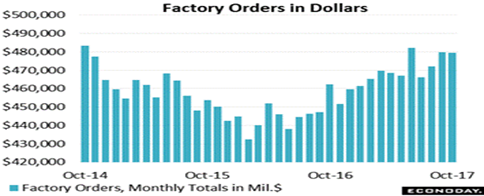
Some good news is that factory orders are soaring. Econoday reports factory orders have had a respectable year, moving to roughly $480 billion per month and near a 3-year high. “Year-on-year, orders are up $17 billion or 3.7 percent. Vehicle orders have been showing recent strength and reflect the rush of hurricane-replacement sales, yet the big contributor has been capital goods where annual gains are approaching 10 percent. And investing in capital goods are needed to expand production and even labor productivity.

image


So we have the Fed wanting to slow down what they see as accelerating inflation, which is probably because they anticipate the increased federal budget deficit (and decreased tax revenues) from Republicans single-minded obsession with tax cuts that may or may not help economic growth.

But if corporate CEOs keep their profits in-house, and won’t spend a substantial amount on increasing wages and salaries, there is no inflation increase, and so no acceleration in GDP, ever.

Harlan Green © 2017

Follow Harlan Green on Twitter: https://twitter.com/HarlanGreen

Posted in Consumers, Economy, Macro Economics, Politics, Weekly Financial News | Tagged , , , , | Leave a comment

Another Great Jobs Report

The Mortgage Corner

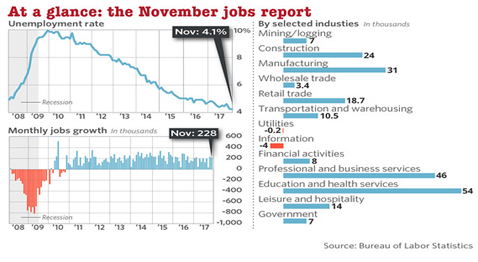
Total nonfarm payroll employment increased by 228,000 in November, and the unemployment rate was unchanged at 4.1 percent, the U.S. Bureau of Labor Statistics reported today. Employment continued to trend up in professional and business services, manufacturing, and health care.

The jobs boost from hurricane rebuilding showed up with 55,000 new jobs in construction and manufacturing. Professional/business services and education/health services added 100,000 jobs, and the service sector added 159,000 jobs overall.

image

Graph: Marketwatch/BLS

The unemployment rate held at 4.1 percent in November, and the number of unemployed persons was essentially unchanged at 6.6 million. Over the year, the unemployment rate and the number of unemployed persons were down by 0.5 percentage point and 799,000, respectively, which means the U.S. economy will continue to grow into 2018, and economic growth could top 3 percent in this fourth quarter, as well.

The best news this week was the second estimate of labor productivity remained at 3 percent rate, which means workers are producing more—though their wages aren’t rising any faster. Annualized output increased 4.1 percent, while labor costs, including benefits, increased just 1.1 percent.

image

This means businesses are increasing capital expenditures to make up for the lack of skilled workers. The meager rise is labor costs is helping productivity, and not boosting inflation. But as the so-called tax reform bill worming its way through congress indicates, there are very little benefits being doled out to those not in the top 1 percent.

The number of persons employed part time for economic reasons (sometimes referred to as involuntary part-time workers) at 4.8 million is down by 858,000 over the year, which shows progress in employment for the marginally employed. These individuals, who would have preferred full-time employment, were working part time because their hours had been cut back or because they were unable to find full-time jobs.

And the Federal Reserve will now raise interest rates another 0.25 percent next week at its FOMC meeting, even though there is a greater danger of disinflation and falling prices.

That’s what happens when $1.5 trillion in tax cuts benefit just the few, and are paid for with $1.5 trillion in benefit cuts for the many—that include Medicare and Medicaid.

Harlan Green © 2017

Follow Harlan Green on Twitter: https://twitter.com/HarlanGreen
Posted in Consumers, Economy, Uncategorized, Weekly Financial News | Tagged , , , , | Leave a comment

U.S. Taxes Are Not High!

Financial FAQs

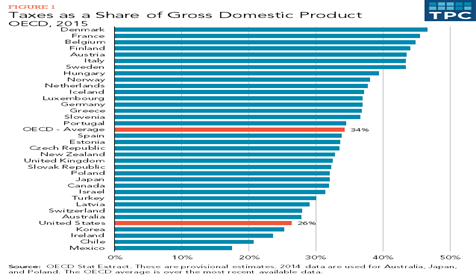
No, our taxes are not too high, and Americans suffer for it. In fact, the non-partisan Tax Policy Center says U.S. taxes at all levels of government represented 26 percent of GDP, compared with an average of 34 percent of GDP for the 34 member countries of the Organisation for Economic Co-operation and Development (OECD) in 2015.

image

Graph: TPC

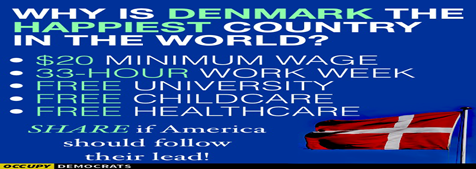
Then why do Americans complain so much about high taxes? It’s because we have to pay for services out-of-pocket that other developed countries’ governments provide—including universal health care, tuition free colleges; services that developed countries consider to be their citizens’ rights.

“In many European countries, taxes exceeded 40 percent of GDP. But those countries generally provide more extensive government services than the United States does,” says the TPC report. “Among OECD countries, only Korea, Chile, Mexico, and Ireland collected less than the United States as a percentage of GDP.”

Actually, the ‘other’ developed countries provide public services as well, including such mass transit conveniences as high-speed trains (in Europe, Japan, and China), and worker-friendly laws—including decent minimum wages, paid maternity leave, and at least 4 weeks paid vacations—the list goes on and on.

image

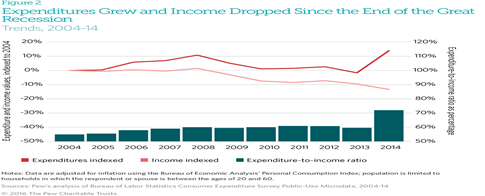
The best way to look at this is what typical American households pay. A 2016 PEW Charitable Trust analysis showed how financially stretched we are.

“After declining during and after the Great Recession, expenditures increased between 2013 and 2014 in particular,” said the study. “…In 2014, the typical American household spent $36,800, but median household income continued to contract. By 2014, median income had fallen by 13 percent from 2004 levels, while expenditures had increased by nearly 14 percent.”

image

Graph: PEW

In other words, declining American household incomes mean Americans are spending more out of pocket for the essential services, such as education and healthcare than other developed countries. About two-thirds of families’ spending goes to core needs: housing, food, and transportation, said PEW.

Alas, it will take an American electorate that finally wakes up to these facts to call for the benefits others enjoy. Why should we deserve less? One reason that hasn’t happened yet is our huge federal deficit—due to the fact that 60 percent of the federal budget goes to the military and defense spending.

Harlan Green © 2017

Follow Harlan Green on Twitter: https://twitter.com/HarlanGreen
Posted in Economy, Keynesian economics, Macro Economics, Uncategorized, Weekly Financial News | Tagged , , , , , | Leave a comment