Dear Fed—Please Don’t Raise Interest Rates Again!

Popular Economics Weekly

The Federal Reserve FOMC meeting this week is expected to conclude with another 0.25 percent rate hike; but it’s happening at the wrong time.  This is the rate that controls credit card interest and the Prime Lending Rate that banks use on short term loans.

Few follow the trajectory of the so-called Treasury yield curve which graphs the difference between short and long term interest rates. The curve is flattening at present—not a good sign for future growth. Instead, it’s historically a sign of slowing growth.

image

Graph: FRED

Why? Short term rates are the cost of money to banks, and longer term interest rates are what they earn on loans. When the difference narrows, bank profits plunge and they lend less to businesses, which shrinks available credit.

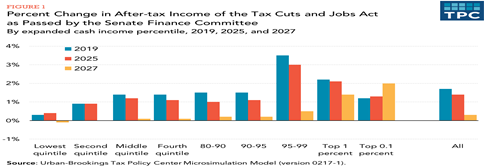
Now is not the time to be shrinking the credit, when we are in the ninth year of this very long-toothed recovery. Especially when the new Republican tax reform bill would increase taxes for anyone earning less than $70,000 per year by 2027, according to the CBO, non-partisan The Tax Policy Center and Joint Committee on Taxation—and this is most of us; more than 80 percent of consumers earning wages and salaries rather than ‘rents’ (i.e. passive income from investments).
image

Graph: TPC

The Fed’s Board of Governors must be focusing on the proposed corporate tax rate cut from 35 to 20 percent, which the Fed predicts will flood the markets with more cheap cash, thus raising the specter of inflation.

But what inflation? The 10-year Treasury is yielding less than 2.4 percent today, as it has been for at least the last three years; still a record low. And that means bond traders see no inflation is even on the horizon, since bond holders look at least 6 months’ ahead for any inflation tendencies. In fact, Fed Chair Janet Yellen said recently she is more worried about disinflation, because they haven’t been able to goose the inflation rate above 2 percent since the end of the Great Recession, when it has been 3 to 4 percent when growth rates were at historical averages.

The Personal Consumption Expenditure Index (PCI) is the Fed’s preferred inflation indicator and still too low to increase demand. It came in at 1.4 percent in October, which is a sign of insufficient demand, even though corporations already are hoarding more than $4 trillion in excess cash and liquid investments.

The culprit is incomes of the 80 percent wage earners. Their average incomes have remained at $37,000 per year for decades with inflation factored in; which means they will continue to shop for bargains. That won’t push prices or inflation any higher.

Harlan Green © 2017

Follow Harlan Green on Twitter: https://twitter.com/HarlanGreen

Posted in Consumers, Economy, Keynesian economics, Politics, Weekly Financial News | Tagged , , , | Leave a comment

New 2018 Conforming Loan Limits

The Mortgage Corner

There is a huge jump in conforming loan limits for 2018 in line with housing price rises, folks. Here are the new numbers. In line with the Federal Housing Finance Agency (FHFA) announcement yesterday, they are increasing their maximum base conforming and high-cost area loan limits on January 1, 2018.

Freddie Mac and Fannie Mae will purchase mortgages secured by properties not located in designated high-cost areas with original loan amounts up to the following limits:

Number of Units

Maximum base conforming loan limits for properties NOT in Alaska, Hawaii, Guam & U.S. Virgin Islands

Maximum base conforming loan limits for properties in Alaska, Hawaii, Guam & U.S. Virgin Islands

2018

2017

2018

2017

1

$453,100

$424,100

$679,650

$636,150

2

$580,150

$543,000

$870,225

$814,500

3

$701,250

$656,350

$1,051,875

$984,525

4

$871,450

$815,650

$1,307,175

$1,223,475

For super conforming mortgages secured by properties located in designated high-cost areas, we will purchase mortgages with original loan amounts up to the following limits:

Number of Units

Maximum loan amount for properties NOT in Alaska, Hawaii, Guam & U.S. Virgin Islands

Maximum loan amount for properties in Alaska, Hawaii, Guam and the U.S Virgin Islands

2018

2017

2018

2017

1

$679,650

$636,150

$1,019,475

$954,225

2

$870,225

$814,500

$1,305,325

$1,221,750

3

$1,051,875

$984,525

$1,577,800

$1,476,775

4

$1,307,175

$1,223,475

$1,960,750

$1,835,200

Stay tuned, as it looks like Santa Barbara County’s super conforming limits are unchanged. We will learn more in coming weeks!  

Harlan Green © 2017

Follow Harlan Green on Twitter: https://twitter.com/HarlanGreen
Posted in Housing, housing market, Weekly Financial News | Tagged , , , | Leave a comment

Q3 Economic Growth Jumps to 3.3% (Revised)

Popular Economics Weekly

It looks like the U.S. economy is charging ahead for the next few quarters, as Q3 Gross Domestic Product was revised from 3 percent to a 3.3 percent growth rate, due to higher exports and capital expenditures.

“The increase in real GDP in the third quarter reflected positive contributions from PCE, private inventory investment, nonresidential fixed investment, and exports that were partly offset by a negative contribution from residential fixed investment. Imports, which are a subtraction in the calculation of GDP,” said the BEA.

Businesses are spending more on equipment such as robots to make up for the labor shortage, and we are exporting more manufactured goods, a sign that the manufacturing sector has finally recovered from the Great Recession.

Good economics says this is an opportunity to pay down our $20 trillion in federal debt. So why are Repubs cutting taxes, which will result in at least $1.5 trillion added to that debt; just when they have to raise the debt ceiling in 9 days, or risk a government shutdown?

Cutting taxes at this time reduces tax revenues, which will also increase the annual budget deficit, and make the debt ceiling negotiations more difficult. Responsible economics should mean finding more ways to pay down that debt, such as closing some of the huge tax loopholes with industries like oil and gas exploration ($6 billion), but one-half of congress that used to be budget hawks now wants even more government debt to pay for their tax breaks?

image

Graph: BEA.gov

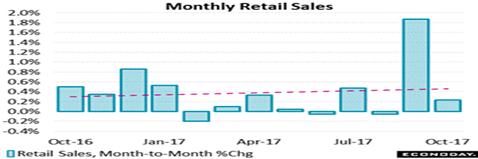
Sad, there is no fiscal responsibility in DC at the moment. Monthly retail sales are helping to boost GDP due in large part to the hurricanes. An upward revision to September puts the monthly retail sales jump at 1.9 percent and a 2-1/2 year high, as consumers in Texas, Florida, Puerto Rico and the Virgin Islands replace autos and everything else lost in the storms. Sales in October understandably slowed but did remain in the plus column at 0.2 percent, said Econoday.

image

Graph: Econoday

What should have been done to bring some fiscal responsibility? Raise the national minimum wage from $7.25/hr where it has been since the last raise in 2009, for starters. This would boost consumer spending, which accounts for two-thirds of economic activity at present.

Across the country, 29 states and Washington, D.C., currently have wages above the federal floor, according to the National Conference of State Legislatures. California and New York are set to soon have the highest minimum wages in the nation, after deals were struck by their governors to raise them to $15 an hour by 2022 and 2018, respectively, with slower increases for smaller businesses.

It’s a simple bit of economics that many do not seem to understand, and it’s hurting economic growth. Henry Ford raised his workers’ daily wages to $5 per day in 1914 so they could afford to buy his cars. He could do this because he had reduced the time to build a Model A Ford from 12 hours to less than 1 hour with a better-designed production line.

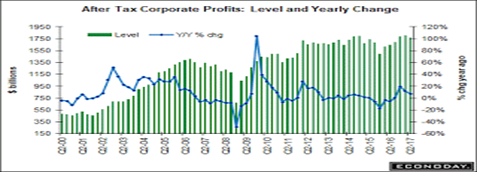
Corporations are making record profits, with Q3 profits up 10 percent annually. So raising their workers’ incomes today will do the same thing—allow workers to buy more products, which increases company profits, which grows our economy!

Harlan Green © 2017

Follow Harlan Green on Twitter: https://twitter.com/HarlanGreen
Posted in Consumers, Economy, Keynesian economics, Macro Economics, Politics, Weekly Financial News | Tagged , , , | Leave a comment

New-Home Sales at 10-yr High

The Mortgage Corner

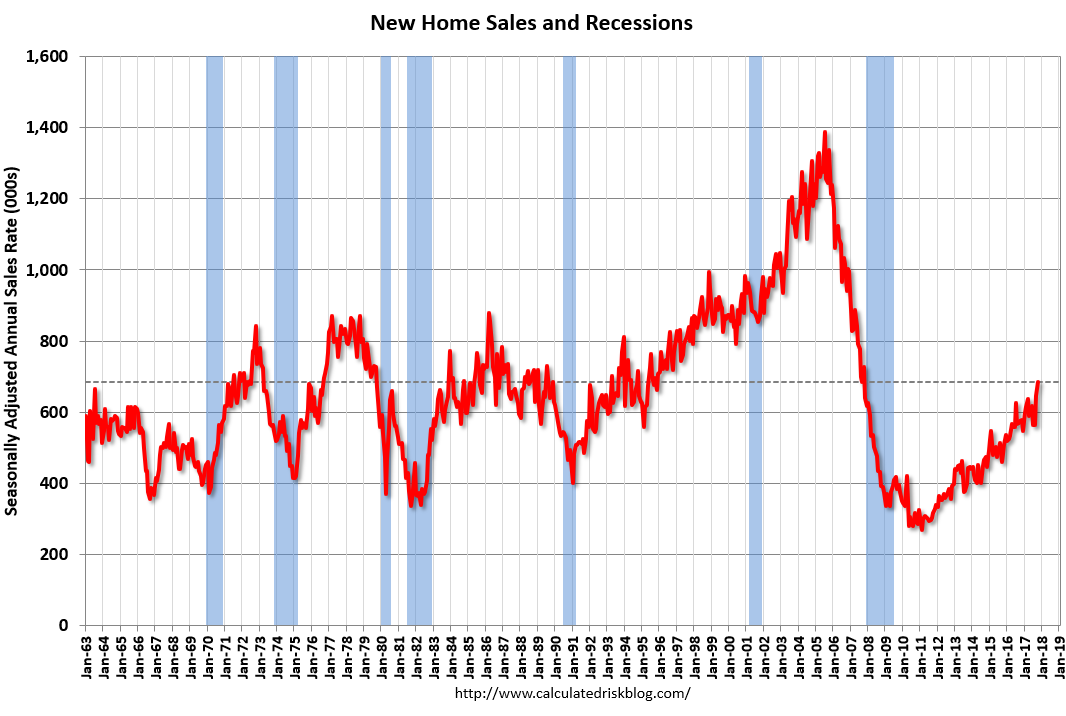
Sales of new single-family houses in October 2017 were at a seasonally adjusted annual rate of 685,000, according to estimates released jointly today by the U.S. Census Bureau and HUD. This is 6.2 percent (±18.0 percent) above the revised September rate of 645,000 and is 18.7 percent (±23.5 percent) above the October 2016 estimate of 577,000.

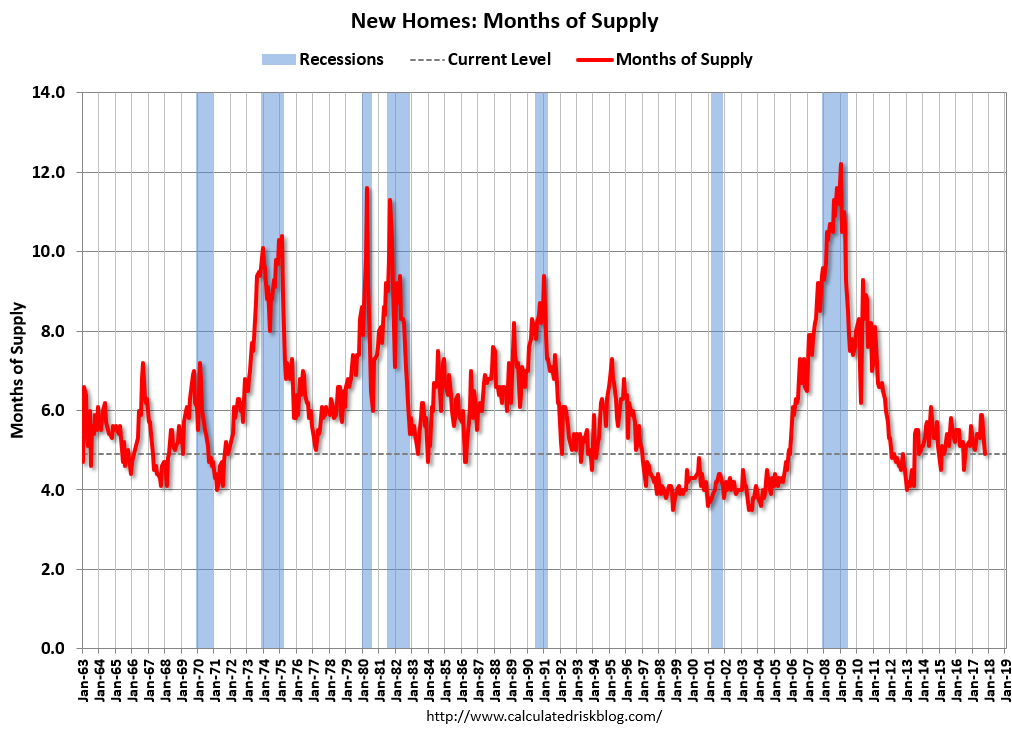
Graph: Calculated Risk

It is the highest sales rate in 10 years, when it reached its 1.4 million unit peak in 2007 at the height of the housing bubble. Such soaring sales tell us homebuyers are hurrying to buy before prices and interest rates rise any higher. But it’s still a meager supply, as there is just a 4.9-month supply of new homes on the market at the current sales rate, which is below the more normal 6-month total.

Graph: Econoday

So there just are not enough homes to satisfy the surging demand for housing in a fully employed economy with wages and household incomes rising substantially for the first time since the Great Recession, as I’ve been saying for weeks. Part of the reason for higher demand—the Gen Y-er, millennial generation want their own living space. They now comprise 42 percent of homebuyers. And first-time buyer total is 32 percent, up from 30 percent last month.

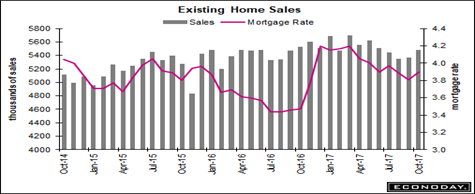
There aren’t enough existing homes to meet demand, either. Total existing-home sales, https://www.nar.realtor/existing-home-sales, which are completed transactions that include single-family homes, townhomes, condominiums and co-ops, increased 2.0 percent to a seasonally adjusted annual rate of 5.48 million in October from a downwardly revised 5.37 million in September. After last month’s increase, sales are at their strongest pace since June (5.51 million), but remain 0.9 percent below a year ago.

“There is solid growth in the number of sales contracts signed before construction has begun, a strong indicator that new single-family home production should continue to grow as we look ahead to 2018,” said NAHB Chief Economist Robert Dietz.


New home sales increased in all four regions. Sales rose 30.2 percent in the Northeast, 17.9 percent in the Midwest, 6.4 percent in the West and 1.3 percent in the South. Some of it may be replacement homes damaged or lost from the Hurricanes, there is clearly still a housing shortage.

And mortgage rates remain at historical lows. The 30-year fixed conforming rate is 3.50 percent, at one origination point. The Hi-balance conforming 30-year fixed is 3.625 percent for the same one origination point.

Harlan Green © 2017

Follow Harlan Green on Twitter: https://twitter.com/HarlanGreen
Posted in Consumers, Economy, Housing, housing market, Weekly Financial News | Leave a comment

Thanksgiving For All!

clip_image001

Let Us Count Our Blessings!

We need to thank so many for what we have—full employment, faster economic growth, higher consumer sentiment and retail sales for the holidays! 

clip_image002

What more do we need?  Perhaps a few more homes built, and tax cuts that will actually help real households.

Harlan Green

Follow Harlan Green on Twitter: https://twitter.com/HarlanGreen

Posted in Uncategorized | Leave a comment

Housing Shortage Continues

The Mortgage Corner

Existing-home sales increased in October to their strongest pace since earlier this summer, but continual supply shortages led to fewer closings on an annual basis for the second straight month, according to the National Association of Realtors.

There just are not enough homes to satisfy the surging demand for housing in a fully employed economy with wages and household incomes rising substantially for the first time since the Great Recession. Part of the reason for higher demand—the Gen Y-er, millennial generation now wants their own living space.

image

Graph: Econoday

Total existing-home sales, https://www.nar.realtor/existing-home-sales, which are completed transactions that include single-family homes, townhomes, condominiums and co-ops, increased 2.0 percent to a seasonally adjusted annual rate of 5.48 million in October from a downwardly revised 5.37 million in September. After last month’s increase, sales are at their strongest pace since June (5.51 million), but still remain 0.9 percent below a year ago.

Lawrence Yun, NAR chief economist, says sales activity in October picked up for the second straight month, with increases in all four major regions. “Job growth in most of the country continues to carry on at a robust level and is starting to slowly push up wages, which is in turn giving households added assurance that now is a good time to buy a home,” he said. “While the housing market gained a little more momentum last month, sales are still below year ago levels because low inventory is limiting choices for prospective buyers and keeping price growth elevated.”

Why has it taken so long for the housing market to recover, as I said last week? Fewer new households are being formed that would require a home of their own

A 2016 San Francisco Fed study by economist Fred Furlong on household formation concluded that many young adults chose alternative residential choices such as living with parents, other relatives, or friends, until now, as I noted.

But there are signs that a readjustment is imminent,” said Furlong. “The current population share of young adults is fairly close to the share that existed at the start of the most recent housing boom. Also, while more young people are living with their parents, they are forming their own households, albeit later in life, leading to higher headship rates over time. Mr. Furlong notes that U.S. Census Bureau projections suggest that household formations will average about 1.5 million per year through 2020, which is much better than the 900,000 annual averages of the last 5 years.”

It will be the largest jump in household formation since the Great Recession, which means many more homes will have to be built to satisfy the demand, when there is already a labor shortage in the construction industry.

This is while total housing inventory at the end of October actually decreased 3.2 percent to 1.80 million existing homes available for sale, and is now 10.4 percent lower than a year ago (2.01 million) and has fallen year-over-year for 29 consecutive months, said NAR. Unsold inventory is at a 3.9-month supply at the current sales pace, which is down from 4.4 months a year ago.

Better news is that nationwide housing starts rose 13.7 percent in October to a seasonally adjusted annual rate of 1.29 million units the highest housing production reading since October 2016, when total starts hit a post-recession high of 1.33 million.

So what needs to be done to increase housing inventories? Marketwatch’s Andrea Riquier says we need double the construction workers we now have to boost construction—another 750,000, at least, enough to meet the surging demand from the millennial generation. They are the 18 to 34 year-olds—now the largest buyer group, comprising 42 percent of homebuyers, according to a September study by the Zillow Group.

The housing shortage is also exacerbated by many existing homes being kept off the market—Marketwatch estimates some 300,000—by investors that scooped up bargains from the housing bubble bust, and continue to rent them out.

Harlan Green © 2017

Follow Harlan Green on Twitter: https://twitter.com/HarlanGreen

Posted in Consumers, Housing, housing market, Weekly Financial News | Tagged , , , | Leave a comment

Our Housing Supply Is Catching Up (Revised)!

The Mortgage Corner

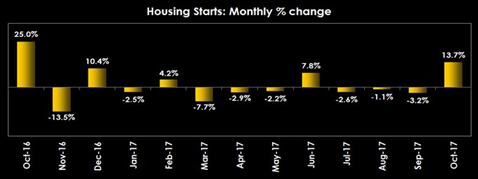
Nationwide housing starts rose 13.7 percent in October to a seasonally adjusted annual rate of 1.29 million units after a slight upward revision to the September reading, according to newly released data from the U.S. Department of Housing and Urban Development and the Commerce Department. This is the highest housing production reading since October 2016, when total starts hit a post-recession high of 1.33 million.

And today’s huge 1.2 percent rise in the Conference Board’s Index of Leading Economic Indicators for October (that predicts future growth trends) should be a sign that housing construction will continue to ramp up in 2018.  Construction needs to catch up to rising household formation as more of the millennial generation’s 18-38 year-olds—the largest generation in history—are now forming their own living arrangements.

“The growth of the LEI, coupled with widespread strengths among its components, suggests that solid growth in the US economy will continue through the holiday season and into the new year,” said Ataman Ozyildirim, Director of Business Cycles and Growth Research at The Conference Board.

image

Graph: Econoday

Rising housing starts are because a total of 3 Quantitative Easings by the Fed has kept interest rates at record lows since 2009; where they still are today. For instance, the 30-yr conformed fixed rate is @ 3.50 percent for one origination point, which was unheard of before the various QE bond buying programs begun under Fed Chair Ben Bernanke in December 2008.

I reported last week that new-home sales shot up 19 percent in September to a consensus crushing annualized rate of 667,000. This is the largest percentage gain in 28 years, folks, which accentuates the rising demand for housing.

The Census Bureau reported ownership increased to 63.9 percent of total households in the third quarter, the highest level since 2014. It is creeping up to the 65 percent historical ownership rate, but remains below the 69 percent clocked at the peak of the housing bubble a decade ago.

“We are seeing solid, steady production growth that is consistent with NAHB’s forecast for continued strengthening of the single-family sector,” said NAHB Chief Economist Robert Dietz. “As the job market and overall economy continue to firm, we should see demand for housing increase as we head into 2018.”

Regionally in October, combined single- and multifamily housing production rose 42.2 percent in the Northeast, 18.4 percent in the Midwest and 17.2 percent in the South. Starts fell 3.7 percent in the West.

Why has it taken so long for the housing market to recover? Fewer new households are being formed that would require a home of their own. A 2016 San Francisco Fed study by economist Fred Furlong on household formation concluded:

“…ownership rates increased during the housing boom of the late 1990s and early 2000s, but fell after 2007. Ownership rates have been driven down by several factors including tougher credit requirements, rising foreclosures, and deteriorating household finances since the Great Recession.”

It is also true that many young adults chose alternative residential choices such as living with parents, other relatives, or friends. There is also a correlation between these living arrangements and both the rise in student debt and the decline in marriage rates.

So we know why the Fed has kept interest rates this low for almost seven years!

“But there are signs that a readjustment is imminent,” said Furlong. “The current population share of young adults is fairly close to the share that existed at the start of the most recent housing boom. Also, while more young people are living with their parents, they are forming their own households, albeit later in life, leading to higher headship rates over time. Mr. Furlong notes that U.S. Census Bureau projections suggest that household formations will average about 1.5 million per year through 2020, which is much better than the 900,000 annual averages of the last 5 years.”

This will continue to boost housing demand, needless to say. Overall permit issuance in October was up 5.9 percent to a seasonally adjusted annual rate of 1.297 million units. Single-family permits rose 1.9 percent to 839,000 units while multifamily permits fell 9.5 percent to 458,000.

An increased supply will also help housing prices, since buying or renting a home has become increasingly expensive for the younger generations.  Continued economic growth will also encourage more millennials—heretofore burdened with student debt and an inadequate housing supply—to strike out on their own.

Harlan Green © 2017

Follow Harlan Green on Twitter: https://twitter.com/HarlanGreen
Posted in Consumers, Housing, housing market, Weekly Financial News | Tagged , , , , | Leave a comment

Is Our Housing Supply Catching Up?

The Mortgage Corner

Nationwide housing starts rose 13.7 percent in October to a seasonally adjusted annual rate of 1.29 million units after a slight upward revision to the September reading, according to newly released data from the U.S. HUD and the Commerce Department. This is the highest housing production reading since October 2016, when total starts hit a post-recession high of 1.33 million.

But it’s still not enough to catch up to rising household formation as more of the millennial generation’s 18-38 year-olds are forming their own living arrangements.

image

Graph: Econoday

Higher starts are mainly because of a total of 3 Quantitative Easings by the Fed to keep interest rates are record lows since 2009; where they are today. For instance, the 30-yr conformed fixed rate is still @ 3.50 percent for one origination point, which was unheard of before the various QE bond buying programs begun under Fed Chair Ben Bernanke in December 2008, one year into the Great Recession.

There is still not enough to supply the newer generations looking for homes. I reported last week that new-home sales shot up 19 percent in September to a consensus crushing annualized rate of 667,000. This is the largest percentage gain in 28 years, folks, which accentuates the rising demand for housing.

The Census Bureau had reported that ownership increased to 63.9 percent of total households in the third quarter, the highest level since 2014. It is creeping up to the 65 percent historical ownership rate, but it remains below the 69 percent clocked at the peak of the housing bubble a decade ago.

“We are seeing solid, steady production growth that is consistent with NAHB’s forecast for continued strengthening of the single-family sector,” said NAHB Chief Economist Robert Dietz. “As the job market and overall economy continue to firm, we should see demand for housing increase as we head into 2018.”

Regionally in October, combined single- and multifamily housing production rose 42.2 percent in the Northeast, 18.4 percent in the Midwest and 17.2 percent in the South. Starts fell 3.7 percent in the West.

Why has it taken so long for the housing market to recover? ? It’s mainly due to fewer new households being formed that would require a home of their own. A 2016 San Francisco Fed study by economist Fred Furlong on household formation concluded:

“…ownership rates increased during the housing boom of the late 1990s and early 2000s, but fell after 2007. Ownership rates have been driven down by several factors including tougher credit requirements, rising foreclosures, and deteriorating household finances since the Great Recession.”

It is also true that many young adults chose alternative residential choices such as living with parents, other relatives, or friends. There is also a correlation between these living arrangements and both the rise in student debt and the decline in marriage rates.

So we know why the Fed has kept interest rates this low for almost seven years!

“But there are signs that a readjustment is imminent,” said the SF Fed. “The current population share of young adults is fairly close to the share that existed at the start of the most recent housing boom. Also, while more young people are living with their parents, they are forming their own households, albeit later in life, leading to higher headship rates over time. Mr. Furlong notes that U.S. Census Bureau projections suggest that household formations will average about 1.5 million per year through 2020, which is much better than the 900,000 annual average of the last 5 years.”

This will continue to boost housing demand, needless to say. Overall permit issuance in October was up 5.9 percent to a seasonally adjusted annual rate of 1.297 million units. Single-family permits rose 1.9 percent to 839,000 units while multifamily permits fell 9.5 percent to 458,000.

An increased supply will also help housing prices, since buying or renting a dwelling of any kind has become increasingly expensive for the younger generations.

Harlan Green © 2017

Follow Harlan Green on Twitter: https://twitter.com/HarlanGreen
Posted in Consumers, Housing, housing market, Weekly Financial News | Tagged , , , , , , | Leave a comment

The Irrelevance of President Trump

Popular Economics Weekly

It’s sad for America that the President of the United States has become irrelevant to most of the problems facing Americans and the world. But it’s heartening as well, because in choosing to return to a 1950’s that never was—the brief emergence of a white middle class—Trump can’t do much damage to future growth by choosing to isolate himself and his constituency from the real world. Do we need a better definition of President Trump’s irrelevance?

Let’s start with his fiasco of an Asian trip, where he fawned over foreign leaders who gave him massive pageants, but no trade concessions, while abandoning the Trans- Pacific Partnership.

The remaining 11 countries, including Japan, Australia, Mexico and Malaysia, said they had revived the Trans-Pacific Partnership (TPP) deal, a multilateral agreement championed under the Obama administration.

The Guardian reported Ministers meeting in Danang, Vietnam agreed on the “core elements” of what was now called the comprehensive and progressive agreement for Trans-Pacific Partnership, a joint statement read.

And “American leaders from state capitals, city halls and businesses across the country have shown up in force” in Bonn, Germany, to discuss carrying out the 2015 Paris climate agreement,” said California Governor Jerry Brown and Michael Bloomberg in today’s New York Times.

This is when President Trump announced at the beginning of his Presidency that he was abandoning the Paris Accord in favor of supporting a return to coal and oil energy. But that isn’t happening for the rest of America, as some 50 percent of U.S. states and cities are represented in Bonn.

“California just extended its cap-and-trade emission program through 2030 and has adopted incentives that will help put 1.5 million electric vehicles on the road by 2025,’ said Jerry Brown, Governor of the sixth largest economy in the world.

image

Graph: Marketwatch.com

And the U.S. just released its latest congressionally mandated Climate Science Special Report that says 2017 wreaked the most catastrophic destruction in 90 years with an estimated $175 billion in property damage. Only the San Francisco Earthquake (1906), Chicago Fire (1871), and Great Flood (1927) caused more destruction.

What is Trump afraid of, that he fawns over Chinese and Russian leaders, while extracting no concessions from them? He was seen to spend more time with Vladimir Putin at the Asia-Pacific Economic Cooperation summit in Vietnam than any other leader.

Even his support of Republicans’ so-call tax reform bills is irrelevant, as he wants Republicans once again to attempt to repeal the Obamacare mandate, when more than 50 percent of Americans now support Obamacare, according to the latest Kaiser Family Foundations Health Tracking Poll.

“When asked whether it was good or bad that the Senate GOP had failed to repeal ObamaCare, answers were more direct. Six out of 10 Americans say that Senate Republicans’ failure to repeal the law was a “good thing,” said the KFF poll, “compared to just 35 percent who disapproved and wanted the law repealed.”

That is irrelevance of the highest order, and as many pundits have noted, it is also the definition of insanity: attempting to repeal Obamacare more than 50 times, and expecting a different result.

Another feature of the tax reform bill is that it requires taking away approximately $1.5 trillion in Medicare and Medicaid benefits to give the wealthiest an unnecessary tax cut. Therefore, it won’t help the shrinking middle class, or any income class, except the top one percent.

Harold Myerson voiced recently in The American Prospect, “The United States now has the highest percentage of low-wage workers – that is workers who make less than two-thirds of the median wage- of any developed nation. Fully 25 percent of all American workers make no more than $17, 576 a year.”

The irrelevance of this President is therefore a real danger to our health and standard of living in so many ways.

Harlan Green © 2017

Follow Harlan Green on Twitter: https://twitter.com/HarlanGreen

Posted in Economy, Macro Economics, Politics, Weekly Financial News | Tagged , , , | Leave a comment

Tax Reform—Who Needs It?

Financial FAQs

Firstly, we know this isn’t real tax reform when the respective Senate and House bills allow an additional $1.5 trillion in debt added to the existing $20 trillion of national debt. Why, when during prosperous times such as these with two consecutive quarters of 3 percent GDP growth, good economics tells us it is time to pay down the debt?

It gets worse. Some spending is cut—up to $1.5 trillion in Medicare and Medicaid for the poorest and elderly. And the House bill proposes cutting out the exemptions for property taxes, state and local taxes, abolishing the estate tax.  The Senate bill cuts the $1m mortgage interest deduction in half to make up for the loss in tax revenue.

And all this is to be done without any input from Democrats. Why would Republicans even try to ram this through with only Republican votes in the first place? That again tells us this isn’t real tax reform, as I said, because their wealthiest supporters and corporations benefit the most, while the poorest and elderly among us get stiffed financially.

So, instead of spending the increased tax revenues on reducing our national debt, they want to give it to their wealthiest donors and corporations—that are already making record profits.

image

This is what happened in 2001, when GW Bush and Dick Cheney blithely erased President Clinton’s preceding four years of actual federal budget surpluses with tax cuts for these same people. What was their rationale?

It was based on a thesis by a then unknown economics graduate student, Arthur Laffer, who drew what came to be known as the Laffer Curve on a napkin in a 1974 meeting with Dick Cheney, then President Gerald Ford’s deputy chief of staff. It was a rationalization never confirmed or evidenced by either history or validated by economic theory.

“The conventional wisdom was: You want more revenue, you raise taxes,” Cheney recalled 30 years later, in a Bloomberg interview reenacting that landmark 1974 meeting. “What Art brought to the table with these curves is that if you wanted more revenue, you were better off if you lowered taxes, to stimulate economic growth and economic activity.”

But that didn’t happen. In 2013 the Center for Budget and Policy Priorities estimated that, when the associated interest costs are taken into account, the Bush tax cuts (including those that policymakers made permanent) would add $5.6 trillion to deficits from 2001 to 2018.  This means that the Bush tax cuts will be responsible for roughly one-third of the federal debt owed by 2018.

So the Clinton surpluses were squandered, instead of bolstering the social security and Medicare funds. Brookings Institution economist William Gale and Dartmouth professor Andrew Samwick, former chief economist on George W. Bush’s Council of Economic Advisers, found that “a cursory look at growth between 2001 and 2007 (before the onset of the Great Recession) suggests that overall growth rate was … mediocre” and that “there is, in short, no first-order evidence in the aggregate data that these tax cuts generated growth.”

When will this foolishness stop, and rational economic thinking return to congress? New York Times’ Paul Krugman says: “..anyone who has paid attention to U.S. politics knows the answer. First, they will lie, unashamedly, about what their bill actually does. Second, they will try to distract working-class voters by stoking racial animosity. That didn’t work too well in Tuesday’s elections, but they’ll keep on trying.”

Harlan Green © 2017

Follow Harlan Green on Twitter: https://twitter.com/HarlanGreen

Posted in Economy, Keynesian economics, Macro Economics, Politics, Weekly Financial News | Tagged , , , | Leave a comment